What Are Still Banks?
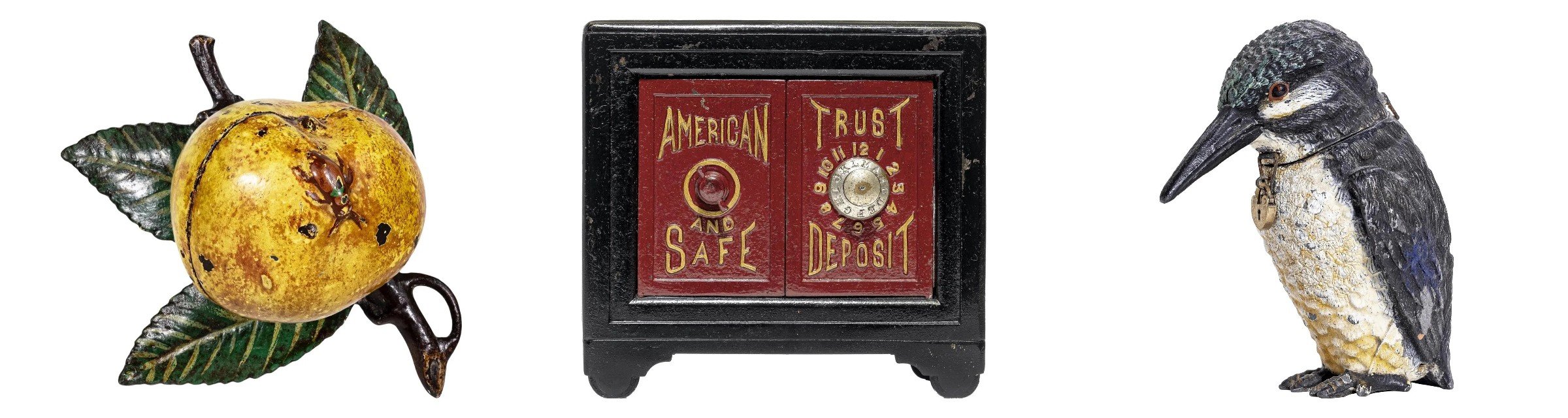
Pictured above, left to right: Apple on Leaves Cast Iron Bank, American Trust Safe Deposit Cast Iron Bank and Large Kingfisher Spelter Bank.
You may already own one and not know that it has a name. Join the Still Bank Club →
What Is a Still Bank?
A still bank is a coin bank that does nothing when you drop in a coin: no lever, no spring, no moving figure. The coin simply goes in and stays there until it's time to empty the bank. Collectors use the term "still" to set these banks apart from mechanical banks, which put on a little show with every deposit.
Chances are you've seen one, or even own one: a cast-iron building on a grandparent's shelf, a ceramic pig, or a small metal safe with a combination dial. Collectors call all of them still banks, whatever they're made of.
Still bank or mechanical bank?
When a coin goes in: on a still bank, nothing happens; the coin just drops in. On a mechanical bank, a figure moves, a lever flips or a spring fires.
Moving parts: still banks have none (some have a lock, dial or trap door to remove coins). Mechanical banks have levers, springs and moving figures.
Getting coins out: still banks use a screw, trap door, key or combination; early pottery banks had to be broken. Mechanical banks usually have a trap door in the base.
Famous examples: Arcade's "Eggman" still bank, a caricature of President William Howard Taft (1910–1913), and J. & E. Stevens's "Teddy and the Bear" mechanical bank.
Did you know? "Breaking the bank" was once literal. Some early banks had no opening at all, so the only way to count your savings was to smash the bank. That's one reason early pottery banks in good condition are so hard to find today.

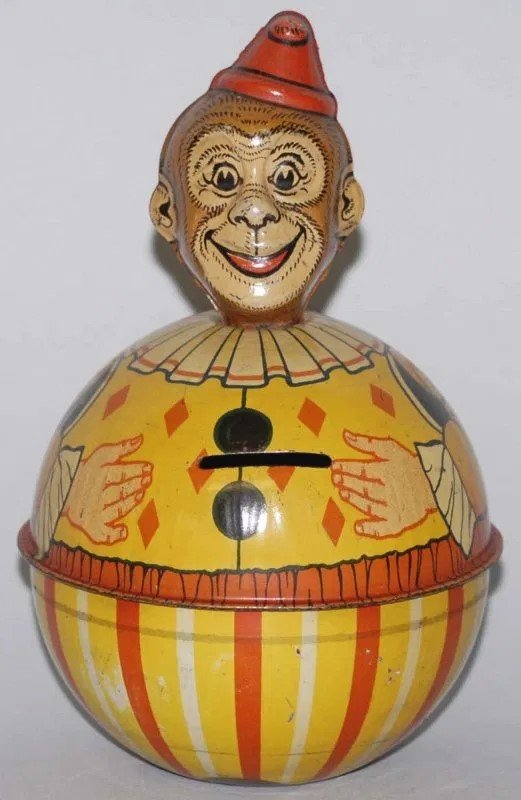

Chein Monkey Still Bank
Reddy Kilowatt Bubble Bank
Celluloid Woodrow Wilson Pocket Bank
There Is No One Kind of Still Bank
Still banks come in nearly every shape imaginable. Most collectors sort them into five broad groups:
Building and architectural banks: houses, banks, churches, castles, skyscrapers and famous landmarks. Pictured: Polychrome Ives Palace Cast Iron Bank.
Figural banks: people, animals, birds and characters. Pictured: Chein Monkey Still Bank and Singing Frog Monk Ceramic Bank.
Safe banks: miniature safes and vaults, often with working combination dials or keys. Pictured: American Trust Safe Deposit Cast Iron Bank.
Advertising and promotional banks: given away or sold by businesses to promote a product or service. Pictured: Reddy Kilowatt Bubble Bank.
Patriotic, historical and souvenir banks: presidents, monuments, world's fairs and great events. Pictured: Celluloid Woodrow Wilson Pocket Bank.
Still banks were made from cast iron, pottery and ceramic, tin, spelter (a painted zinc alloy), wood, glass, celluloid, composition and plastic. Some collectors focus on a single material; others love the variety.
A Brief History of Still Banks
People were saving coins in pottery and china banks long before the first American cast-iron bank. Many of those early banks had no way to open them, so they had to be broken to get the money out.
In the 1800s, new manufacturing methods made it possible to cast durable iron banks in almost any shape. Their popularity peaked from the late 1800s into the early 1900s. Most cast-iron banks were made in two or more sections held together by a screw, so the money could be removed without destroying the bank.
The names behind these banks are the names you'll see in every auction catalog today:
J. & E. Stevens Co. of Cromwell, Connecticut, an early giant of cast-iron toys and banks
Ives, known for finely detailed banks such as the Palace bank
Arcade Manufacturing Co. of Freeport, Illinois
A.C. Williams Co. of Ravenna, Ohio, one of the most prolific makers
Grey Iron Casting Co. of Mount Joy, Pennsylvania
Hubley, Kenton and J.M. Harper, among many others
Did you know? The General Butler bank (pictured below), made by J. & E. Stevens and patented in 1879, pokes fun at Benjamin Franklin Butler, a Civil War general who ran for president in 1884 on the Greenback Party ticket. The bank shows him as a frog clutching a greenback, with the slogan "Bonds and toddy for the masses" on his arms.
Banks followed the headlines. When President Theodore Roosevelt famously refused to shoot a captured bear in 1902, the "teddy bear" craze swept the country, and Arcade answered with Teddy Bear still banks. Arcade's "Eggman" bank (1910–1913) caricatured President William Howard Taft. A.C. Williams sold a gold-painted Billiken, the good-luck charm known as "the god of things as they ought to be."
Over time, makers added tin (J. Chein & Co. made colorful lithographed tin banks), celluloid, composition and, later, plastic. Businesses discovered that a bank on the kitchen shelf was a year-round advertisement. Advertising banks became so popular that some, like Reddy Kilowatt, now sell for more than many cast-iron banks.
Did you know? In the 1950s and 1960s, kids could get a Mr. Peanut bank by saving Planters peanut butter labels or peanut wrappers. Collectors still argue about how many colors were made.
Why Collecting Still Banks Is a Great Hobby
A still bank is a small object with a big story. It was made to teach a child to save a penny, and it ended up preserving a slice of history.
You can start anywhere, on any budget. Still banks turn up at flea markets, antique malls, estate sales, garage sales, online and at the major toy-and-bank auction houses. One longtime club member traces his whole collection to a J. Chein "Monkey Tilts Hat" bank his mother found at a garage sale for 10¢. At the other end of the scale, rare banks bring serious money at auction. You set the pace.
It's history you can hold in your hand. Banks were made to look like whatever people cared about at the time: presidents and politicians, skyscrapers and hometown banks, world's fair souvenirs, comic strip characters and advertising mascots. Line them up and you're looking at a century of life, told in iron, tin and clay.
The variety never runs out. The standard reference book alone pictures more than 1,670 still banks in color, and collectors still report new finds every year. Recent Penny Bank Post issues have announced banks that no one in the club had ever recorded.
Every bank is a detective story. Who made it? When? Is the paint original? Is the screw correct? Is this a known variation, or something nobody has documented? Answering those questions is half the fun.
The thrill of the hunt is real. One member got a phone call from collecting friends about a pristine 1914 Hubley nickel-plated "Boy with Large Football" bank in a local, in-person-only auction the next day. He left home at 4 a.m., drove about six hours through rush-hour traffic, won the bank, and then called his friends to thank them. They were as happy as if they'd won it themselves.
They display beautifully. Most still banks are just a few inches tall. A single shelf can hold a whole neighborhood of cast-iron buildings or a menagerie of animals.
It's a hobby to share. Still banks were made for children, and they still delight them. Many collectors started with a bank from a parent or grandparent. Members use the stories behind their banks to spark a love of history in the next generation, and to teach the simple habit of saving.
The people are the best part. Collectors are generous with what they know. They'll tell you the story behind a bank, help you spot a reproduction and become friends you look forward to seeing every year.
Join the Still Bank Club →
Getting Started: Tips for New Collectors
Get the book before the bank. The Penny Bank Book: Collecting Still Banks by Andy and Susan Moore (1984) pictures more than 1,670 still banks. Each has a "Moore number" and a scarcity rating, and you'll see both in auction listings and club articles. For example, A.C. Williams's gold Billiken bank is Moore #74, rated "A": one of the easier banks to find, which makes it a great first purchase.
Handle as many real banks as you can. The fastest way to learn what an original looks and feels like is to hold one. Conventions, regional meetings and members' collections are the best classrooms.
Turn it over. The bottom of a bank often tells you more than the top. Different versions of the same bank can have different bases, and the screw can reveal whether the bank is original. The original Billiken bank, for instance, uses a round-head screw rather than the flat-head screw found on most still banks.
Let a focus find you. Some collectors stick to building banks, safes, advertising banks or a single maker. Others buy whatever makes them smile. Both are right.
Learn what drives value. Rarity, condition and originality matter most: original paint, the correct screw, no cracks and no replaced parts.
Buy from people who stand behind what they sell. Ask about originality before you pay, and get a return policy in writing.
Keep records. Note where you bought each bank, what you paid, its Moore number and a photo. Your future self (and your heirs) will thank you.
Ask questions. Collectors love to talk banks. There's no such thing as a dumb question at a club meeting.
Watch for Reproductions
Thousands of reproduction cast-iron banks have been made, some honestly sold as reproductions and some meant to fool. A few warning signs:
Colors that are too bright. Originals from around 1900 were painted in muted colors. Bright pink or bright green is a red flag.
The wrong kind of rust. Rust on reproductions tends to be reddish and flaky.
Soft details and gaps. Reproductions are often cast from an original, so details look blurry and the halves may not fit tightly.
The wrong hardware. Check the screw and the bottom. They often give a reproduction away.
Re-issues. Some companies legally re-made old designs. These are collectible in their own right, but shouldn't be priced as originals.
When in doubt, ask a club member before you buy.
From the Penny Bank Post: Good Reads for Beginners
Every issue of our full-color magazine is packed with research written by collectors, for collectors. Here's a taste from recent issues.
Should I Go to the SBCCA Annual Convention? by David Dods (August 2022). Worried you don't know anyone or don't know enough? Here's what really happens at a convention, and why first-timers keep coming back.
SBCCA Has Some of the Nicest People! by John Marquand (December 2023). A tip from collecting friends, a 4 a.m. start and a nail-biting auction for a 1914 Hubley bank.
What Kind of Bottom Do You Have? by Dan Penn (August 2023). Why the underside of a bank can tell you more than the top.
Billiken: The God of Things as They Ought to Be by Gary Ferguson (December 2022). A friendly first bank to collect, and the clues that tell the versions apart.
"Teddy Bear" vs. "Billy Possum" by Gary Ferguson (April 2022). How a 1902 hunting trip created the teddy bear, and a wave of banks to go with it.
General Butler Bank by Dr. Ed Brown III (August 2021). The story behind one of the most famous political banks, shown on this page.
Plastic Figural Advertising Banks by Guy Williams (August 2020). Mr. Peanut, Reddy Kilowatt and why some advertising banks outsell cast iron.
Milwaukee Celluloid Pocket Banks by Bob Peirce (September 2020). Small celluloid banks that hometown banks handed out between World War I and World War II, often to new parents, to promote saving.
Still Banks of Comic Strip Characters by Gary Ferguson (April 2023). The funny pages, preserved in iron.
2022 Discovery by Kevin Armstrong (August 2023). Proof that collectors are still finding banks no one knew existed.
Members receive three new issues a year, plus decades of back issues online. Join to read more →
Why Join the Still Bank Club?
You can collect on your own. But since 1966, the Still Bank Collectors Club of America has helped collectors learn faster, buy smarter and have a lot more fun doing it. Our members live across the United States and Europe, and many of them got started exactly where you are now.
The Penny Bank Post. Our full-color magazine arrives three times a year, with 30+ pages of member-written research, new discoveries, convention news and special projects.
The annual convention. Held each June in a different part of the country. There's a new-member orientation, guest speakers, seminars and a still bank auction. Members set up banks in their hotel rooms and everyone goes "room hopping" to see hundreds of banks for sale or trade, from affordable common banks to rare treasures. You'll also visit members' homes to see how they display their collections. First-timers are made to feel at home, and most come back year after year.
Regional meetings. Smaller get-togethers between conventions, hosted by members in their homes, where collectors share a meal, talk banks and buy, sell and trade.
The members-only website. Thousands of bank images, old advertisements, patent papers, slide shows and videos, plus decades of Penny Bank Post back issues.
Books you can't buy anywhere else. Members have produced reference books that aren't sold commercially, including the Pocket Bank Book, Cast Iron Building Banks, Painted German Spelter Banks, Political Banks and the Safe Bank Book.
Expert advice before you buy. Not sure whether that bank is original or a reproduction? Ask a member who has handled hundreds of them. Avoiding a single bad purchase can pay for your membership many times over.
Friendship. The banks bring us together. The people keep us coming back. As one member put it in the Penny Bank Post: "You meet the nicest people in SBCCA!"
Individual, Household and Overseas memberships are available. Join online in a few minutes, or mail in an application with a check.
Ready to become part of the collecting community? Join today →
Not quite ready? Keep exploring with us on Facebook: Visit the Still Bank Club on Facebook


Singing Frog Monk Ceramic Bank
Polychrome Ives Palace Cast Iron Bank
General Butler Cast Iron Bank
You Might Be a Still Bank Collector If…
If you've ever flipped over a ceramic pig in a stranger's kitchen to check for a maker's mark… you might be a still bank collector.
If you own more banks than you have money to put in them… you might be a still bank collector.
If your bookshelves are reinforced with steel brackets, but your savings account isn't… you might be a still bank collector.
If someone says "Moore" and you answer with a number… you might be a still bank collector.
If you can't walk past a flea market table without asking, "Got any iron?"… you might be a still bank collector.
If you've ever whispered the word "repaint" the way other people whisper a cuss word… you might be a still bank collector.
If you've pulled out a flashlight and a magnifying glass at a yard sale, and the seller raised the price… you might be a still bank collector.
If you've left the house at 4 a.m. to drive six hours for one bank, and called it a great day… you might be a still bank collector.
If you've ever said, "It's only a little one," while carrying in your fourth bank this month… you might be a still bank collector.
If you've spent a whole convention evening "room hopping" and never once saw your own room… you might be a still bank collector.
If you've stared at the bottom of a bank longer than you've looked at your own wedding photos… you might be a still bank collector.
If you own a whole city skyline and none of it is real estate… you might be a still bank collector.
If your will has a separate section titled "The Banks"… you might be a still bank collector.
And if you're reading this list and nodding along… you're definitely a still bank collector. Welcome home. Join the club!