Convention Banks and Favors
Whether recognized as “official” or as a “favor” shared with convention attendees, these banks were created to commemorate SBCCA Annual Conventions. They illustrate that SBCCA members not only collect - but create - the banks they cherish!
-
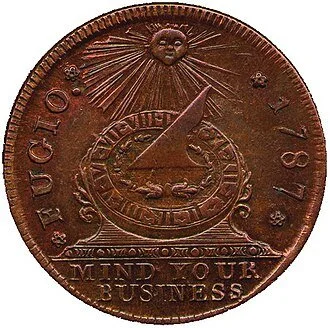
If you have ever brought home a newly purchased penny bank and heard the gentle rattle of coins inside, you may have imagined discovering something as valuable as the bank itself. While that dream is rarely realized, there are two early American “pennies” that would make any collector particularly fortunate.
On April 21, 1787, the Congress of the Confederation authorized the design of an official copper cent, later known as the Fugio cent. The coin earned its name from the image of the sun shining upon a sundial, accompanied by the word “Fugio,” Latin for “I flee,” a reference to the passage of time. Many historians attribute the design to Benjamin Franklin, who is also credited with the inscription at the bottom of the coin: “Mind your business.” The design drew inspiration from the 1776 Continental dollar pattern, which was produced but never circulated. The Fugio cent stands today as one of the earliest expressions of American identity in coinage.
Equally significant is the Chain cent, America’s first large cent and the first circulating coin officially produced by the United States Mint. Struck in 1793, the coin was composed of copper and featured powerful symbolism. The obverse displayed a stylized Liberty with flowing hair, facing right, with the inscription “LIBERTY” above and the date below.
The reverse design, for which the coin is named, featured an interlocking chain of fifteen links representing the fifteen states in the Union at that time—the original thirteen colonies along with Vermont and Kentucky. Inside the chain appeared the words “ONE CENT” and the fraction 1/100, while “UNITED STATES OF AMERICA” encircled the outer edge. On the first working die, insufficient space required the final word to be abbreviated to “AMERI.”
Approximately 36,000 Chain cents were struck in late February and early March of 1793. Public reaction, however, was less than enthusiastic. Some critics found the Liberty portrait unattractive, while others objected to the chain motif, interpreting it not as unity but as a troubling symbol of bondage. By March, production ceased when the Mint exhausted its supply of planchets. During this pause, a new design—the Wreath cent—was prepared and approved, replacing the short-lived but historically significant Chain cent.
Who knows what you may find in one of your banks! Happy Collecting!
-
Where are they now?
Do you have one of these banks?
1974 Convention attendees were given the opportunity to draw numbers for the Rocking Horse Bank. Banks were assigned numbers and distributed to club members in the order drawn. A total of 85 banks were produced with 36 being given out at the 1974 Convention. Below is the list of convention attendees and the bank number each drew.
Bank # - 1974 Convention Attendee
# 1 - Hall Henry
# 2 - Mrs. Aileen Gravelle
# 3 - Dick Hale
# 4 - Mrs. Wand Bondi
# 5 - John Mederic
# 6 - Lin Pickle
# 7 - Bernard Ellinghaus
# 8 - Sid Partridge
# 9 - Ed Mosler
#10 - Jerry Lange
#11 - Addie Henry
#12 - Andy Moore
#13 - Bob Smith
#14 - Gerhard Riegraf
#15 - Don Markey
#16 - Ed Neuguth
#17 - Ralph Craig
#18 - Al Davidson
#19 - Gordon Jorgensen
#20 - Ray Green
#21 - Bob Watkins
#22 - Bill Werbell
#23 - Roberta Bertz
#24 - Bud Harris
#25 - Bill Robinson
#26 - John Willis
#27 - Carl White
#28 - Ralph Dye
#29 - Fred Green
#30 - Bob Warner
#31 - Louis Filler
#32 - Bob McCumber
#33 - Ed Russell
#34 - Ralph Berman
#35 - Frank Mitchell
#36 - Calvin Ander
-
The Remaining Banks
Were distributed to the Membership
Bank # - Original Bank Owner
#37 - Tommy Ennis
#38 - A.T.E. Anderson
#39 - John Smith
#40 - Ronald Volkman
#41 - Joan Lathouse
#42 - Joe Olimpio
#43 - Mr. & Mrs. George Kusmik
#44 - Michael Jordan
#45 - Brian Cleary
#46 - Ivan Cleaver
#47 - Richard Fox
#48 - James Maxwell
#49 - Philip Deeds
#50 - Muriel Lewis
#51 - Frank Newton
#52 - Edgar Buchardt
#53 - Richard Lohr
#54 - Terry Hagedorn
#55 - Mrs. Leonard Bellin
#56 - Mrs. Irma Scofield
#57 - Peter Van Vreumingen
#58 - Charles Olsen
#59 - Oscar Ghebelian
#60 - Robert Vicic
#61 - Stanley Kasper
#62 - Helen Kasper
#63 - John Haley
#64 - W.J. Taylor
#65 - Joseph Dallaire
#66 - Mrs. G. Robert Herberger
#67 - Robert J. Craig
#68 - Mr. & Mrs. Fred Fisk
#69 - Charles Morrison
#70 - Robert E. Smith
#71 - Kenneth R. Tillman
#72 - Charles Milks
#73 - Richard Brizendline
#74 - F.H. Griffith
#75 - Leon J. Perelman
#76 - Chester Bible
#77 - Richard Genza
#78 - Alvin Goldstein
#79 - William Burkey
#80 - Darrel V. Myers
#81 - Jerry Erickson
#82 - William Kidder
#83 - Bert Whiting
#84 - George Knerr (original bank)
#85 - Dorothy Knerr (Cast Brass)
-
1971 - Convention #4
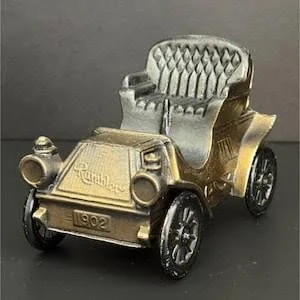
Horseless Carriage Bank
Produced by Banthrico Manufacturing Company, the Horseless Carriage Bank measures 5 ¼ x 3 ½ inches. A plate affixed to the bank reads Still Bank Collectors Club, 1971, Philadelphia.
The bank was modeled after the 1902 Rambler, an early "horseless carriage" manufactured by the Thomas B. Jeffery Company.
The bank features a brushed copper, brass, or bronze-tinted finish.
Presented to convention attendees, the bank originally cost $5.00.
-
1972 - Convention #5
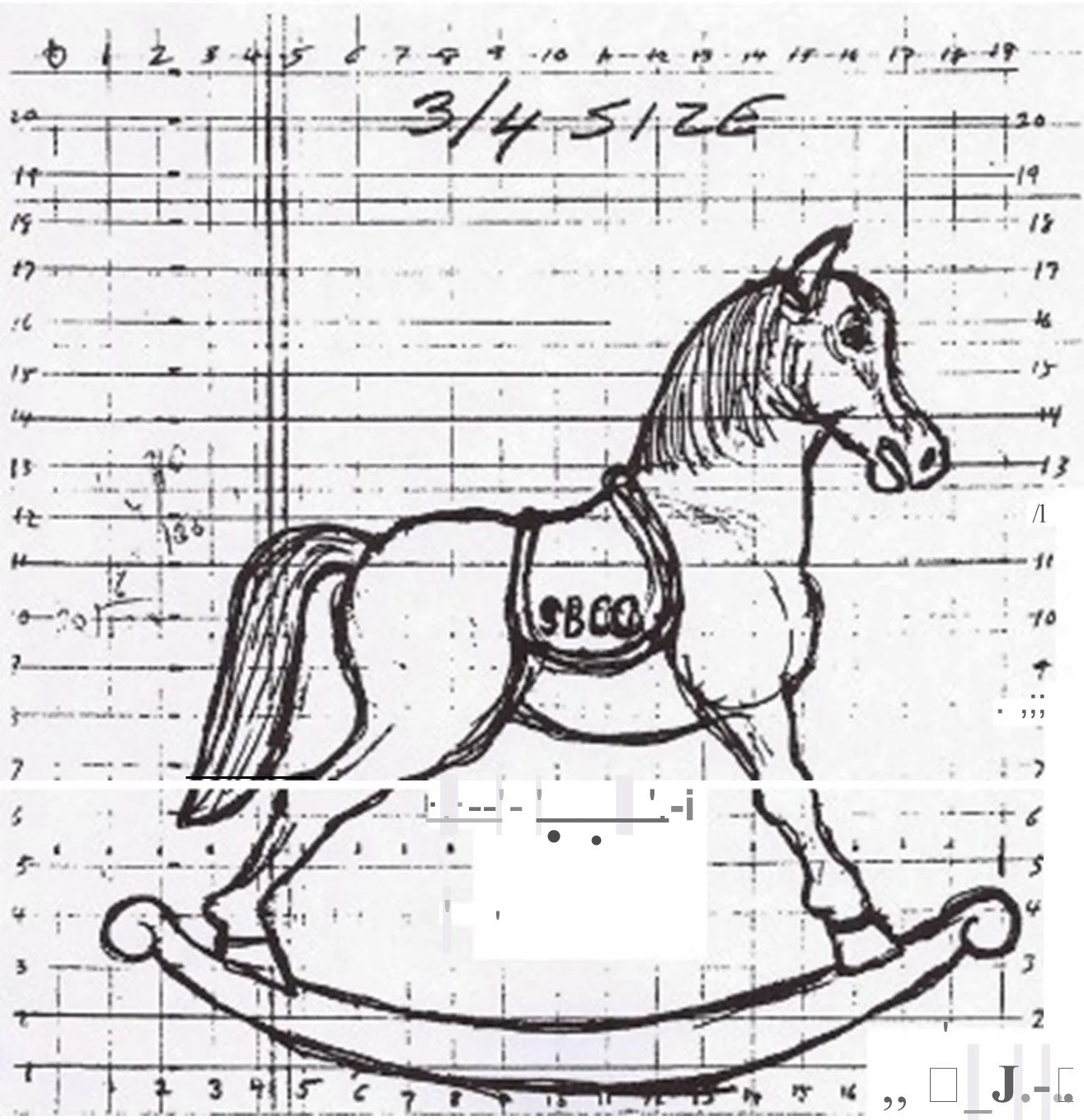
Design Preview - Sketches of Boy on Rocking Horse club bank
Penny Bank collector George Casper Knerr II decided to design and produce a cast iron Hobby Horse Bank limited to an edition of 85 for the 1975 SBCCA convention in Lancaster, Pennsylvania. The Hobby Horse was adopted as the official symbol of the SBCCA in June, 1975.
Designing and producing penny banks was not a new avocation for George for he had at least 14 other banks to his credit. He was working on a Carter Peanut Bank and a Charlie Brown Character Bank when he died in 1979. By any measure, George Casper Knerr II will be remembered for his unusual and well crafted penny banks, and especially for creating the SBCCA club logo.
The Hobby Horse Bank is 5-5/8" high and is cast in two pieces held together with a screw. From the small coin slot on top of the horse to the cast keying tabs that keep the bank halves aligned, George's craftsmanship is evident. The bank is painted white with a red saddle sporting the letters SBCCA highlighted in gold.
(HOBBY HORSE BANK DESIGN SKETCHES by Don Duer)
-
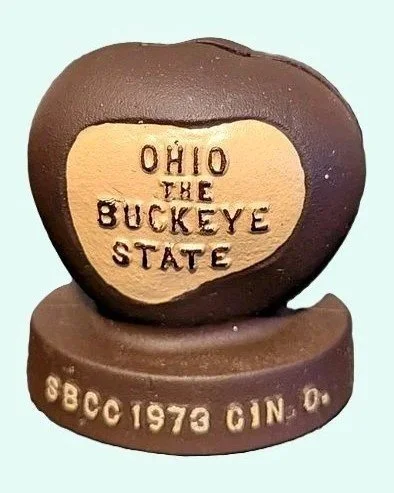
1973 - Convention #6
Buckeye Bank
This cast iron bank was designed by Lou Filler. Originally priced at $6.00, the inscription on the bank includes “Ohio The Buckeye State” and “SBCC 1973 in Ohio.” It was not uncommon for the earlier banks to use SBCC rather than SBCCA as the club identifier.
A Buckeye is the nut of the Ohio Buckeye tree (Aesculus glabra), the official state tree of Ohio, which resembles a deer's eye (or "buck's eye"). They are considered good luck charms.
Since the mid-1800s, “Buckeye” has been a nickname for Ohioans. It became popular during William Henry Harrison’s presidential campaign, when supporters made souvenirs from buckeye wood. Ohio State University’s mascot is the Buckeye, and students and alumni proudly call themselves Buckeyes. The name even inspired a sweet treat: chocolate buckeyes. These peanut butter candies are dipped in chocolate to look like the nut—but unlike the real nut (which is generally considered poisonous to humans) , the candy is safe (and delicious) to eat!
-
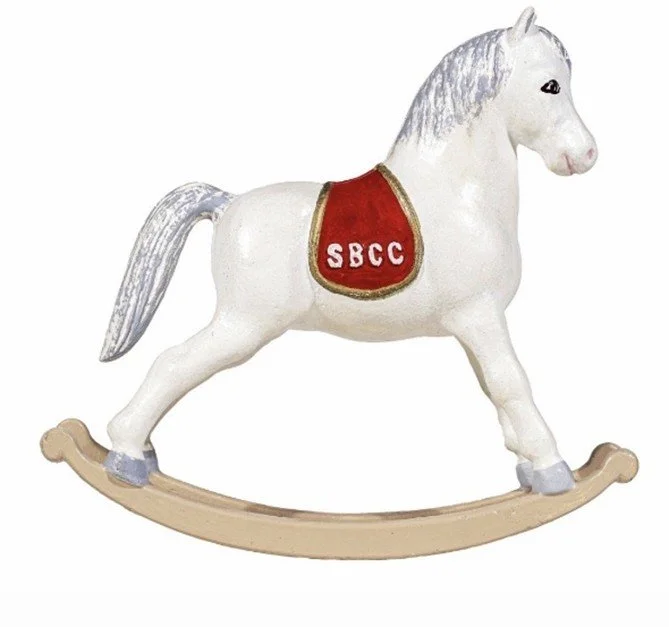
1974 - Convention #7
Rocking Horse Bank
Designed by George Knerr, this 5 ¾-inch to 6-inch painted bank was produced in a limited run of approximately 75 pieces.
You can find information about the Rocking Horse bank in these Penny Bank Post issues:
Penny Bank Post, #2 1975, p. 9 “Sale of Rocking Horse Bank Ends Soon”
Penny Bank Post, December 1980, p.83, “Rocking Horse Banks”
Penny Bank Post, #3 1985, pp. 36-37, “The Celebrating Rocking Horse (20th Anniversary)”
Penny Bank Post, #3 1993, pp. 18-19 “Hobby Horse Bank Design/Sketches”
Penny Bank Post, April 1999, p.17 “Official SBCCA Rocking Horse”
Penny Bank Post, December 2019, P. 21 “SBCCA Rocking Horse
Penny Bank Post, December 2024, pp. 32-34 “The Story About the SBCCA Rocking Horse Bank”
-
1975 - Convention #8
Lancaster, PA
Rocking Horse Bank officially adopted as the club emblem
The Club has had three “official” symbols since it was formed in 1966: the Cat Toy Bank, Savings Bank, and Rocking or Hobby Horse.
At the June 1975 Convention in Lancaster, Pennsylvania, former Member Ken Tillman “suggested that we adopt the Rocking Horse Bank as our official emblem on the change of letterhead for our stationary” and it was approved, thereby becoming the official Club symbol.
Source: Penny Bank Post, 1979 August, p. 22
-
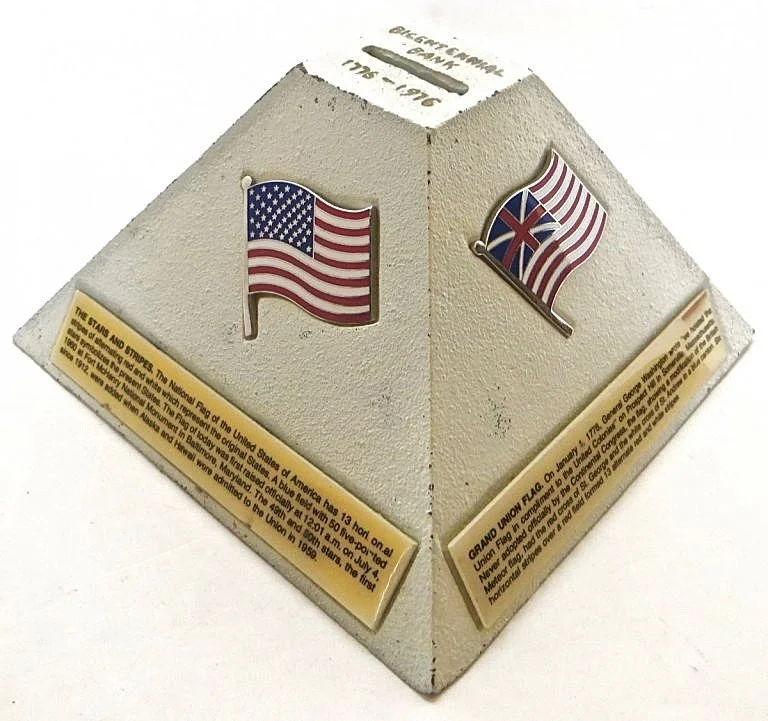
1976 - Convention #9
The Flags Bank/The Bicentennial Bank
This cast iron bank was made to commemorate the 200-year anniversary of America. It is inscribed at the top 1776-1976. The bank is painted in white with four metal flags applied and a description of each below in a recessed enamel “tag.” The base plate is embossed “Still Bank Collectors Club of America and “Limited Edition of 200.″
Dimensions: 6″ x 6″ (Base plate) x 3 1/2” high
A leaflet titled “The Flags Bank” accompanied the bank.
Learn More: Penny Bank Post, 1976 Summer, pp. 2, 6, and 12.
-
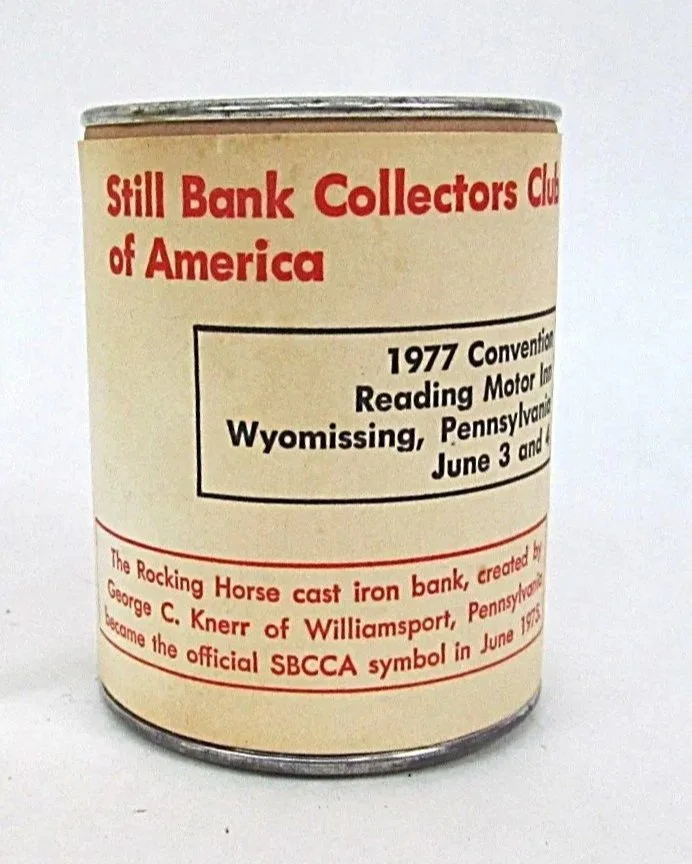
1977 - Convention #10
Tin and Carboard Can Bank
The 3 1/2” tin and cardboard can bank was designed for the 1977 convention by Advertisers Publishing Company of Ann Arbor, Michigan,
Note the reference to the Rocking Horse cast iron bank becoming the official SBCCA symbol.
-
1978 - Convention #11
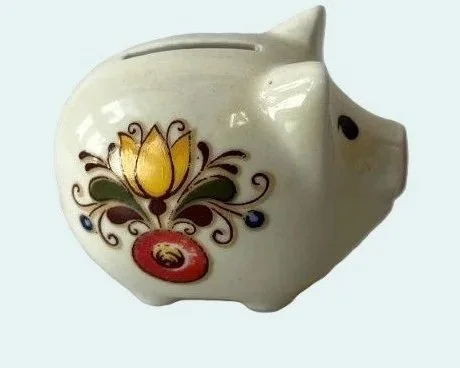
Penny Pig Bank
This porcelain bank was designed and produced by Gerhard Riegraf. Both Gerhard Riegraf and Ulrike Riegraf-Blank have been enthusiastic supporters of the Still Bank Club. They have not only designed convention banks but were gracious hosts when club members visited Germany.
The Penny Pig bank measures 6 2/3” x 2 3/8”. A white bank it features a floral design on one side and SBCCA Convention Lancaster Pennsylvania on the opposite side.
-
1979 - Convention #12
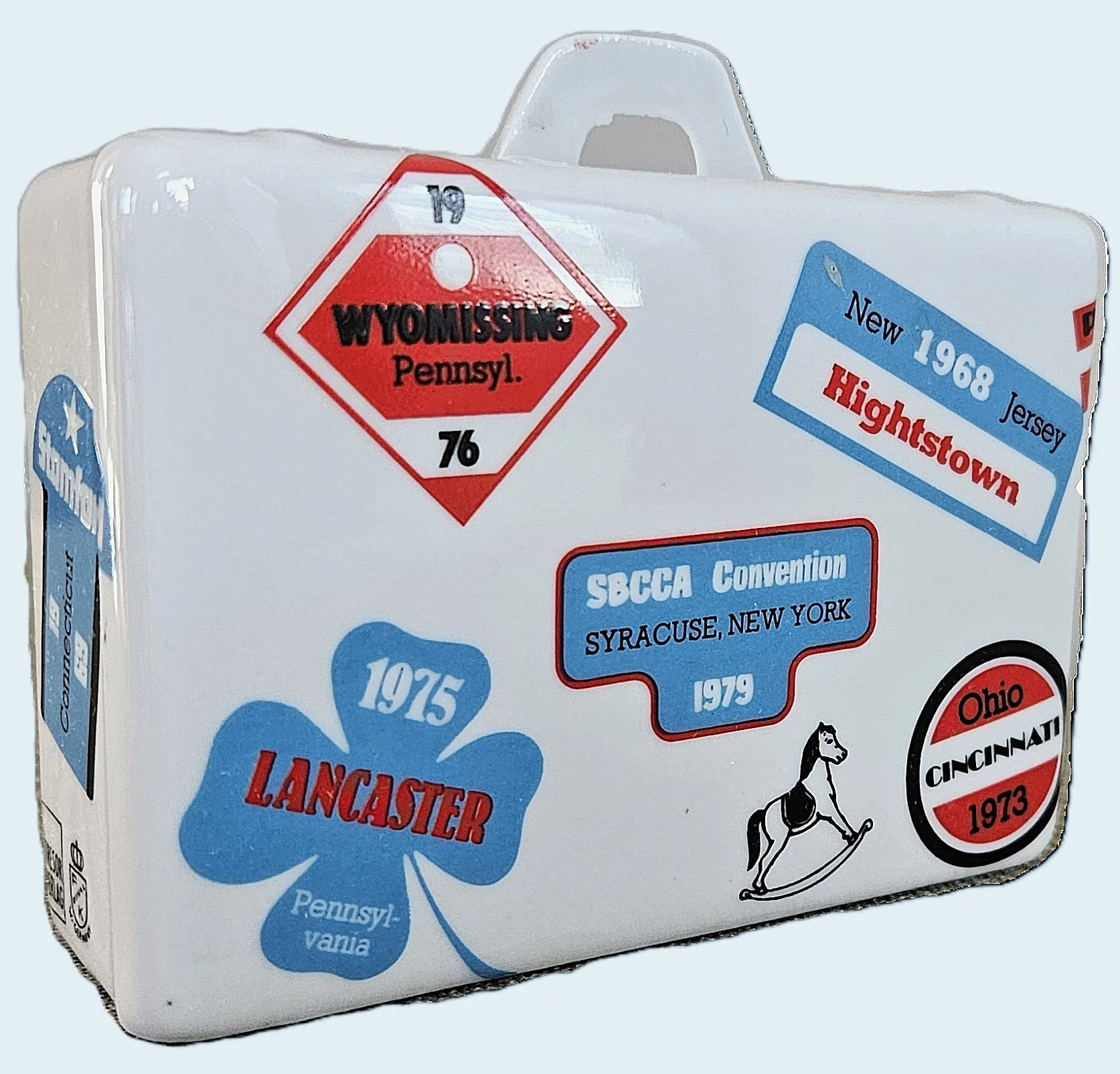
Suitcase Bank
The suitcase bank features colorful replicas of travel stickers from the locations of past SBCCA conventions. Another bank designed and produced by Gerhard Riegraf.
The bank measures 3 1/8” long 2 1/2” high and 1 1/8 “deep. There were 160 of these banks produced in white and 50 produced in light tan.
-
1980 - Convention #13
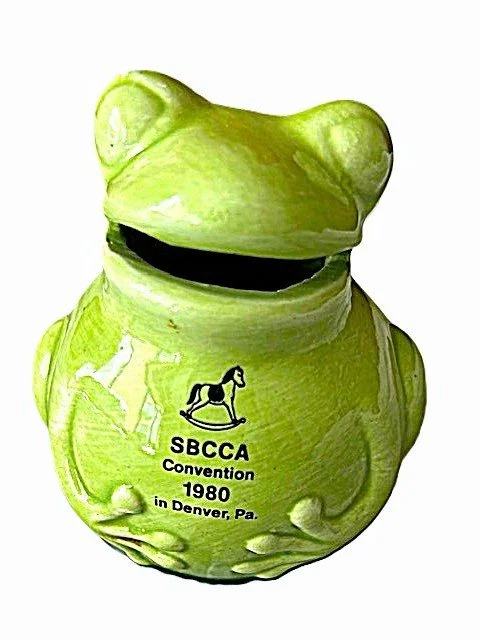
Frog Bank
The ceramic Frog Bank was produced by Gerhard Riegraf. The bank measures 2 ¾ “ high and the front reads SBCC Convention 1980 in Denver PA.
-
1981 - Convention #14
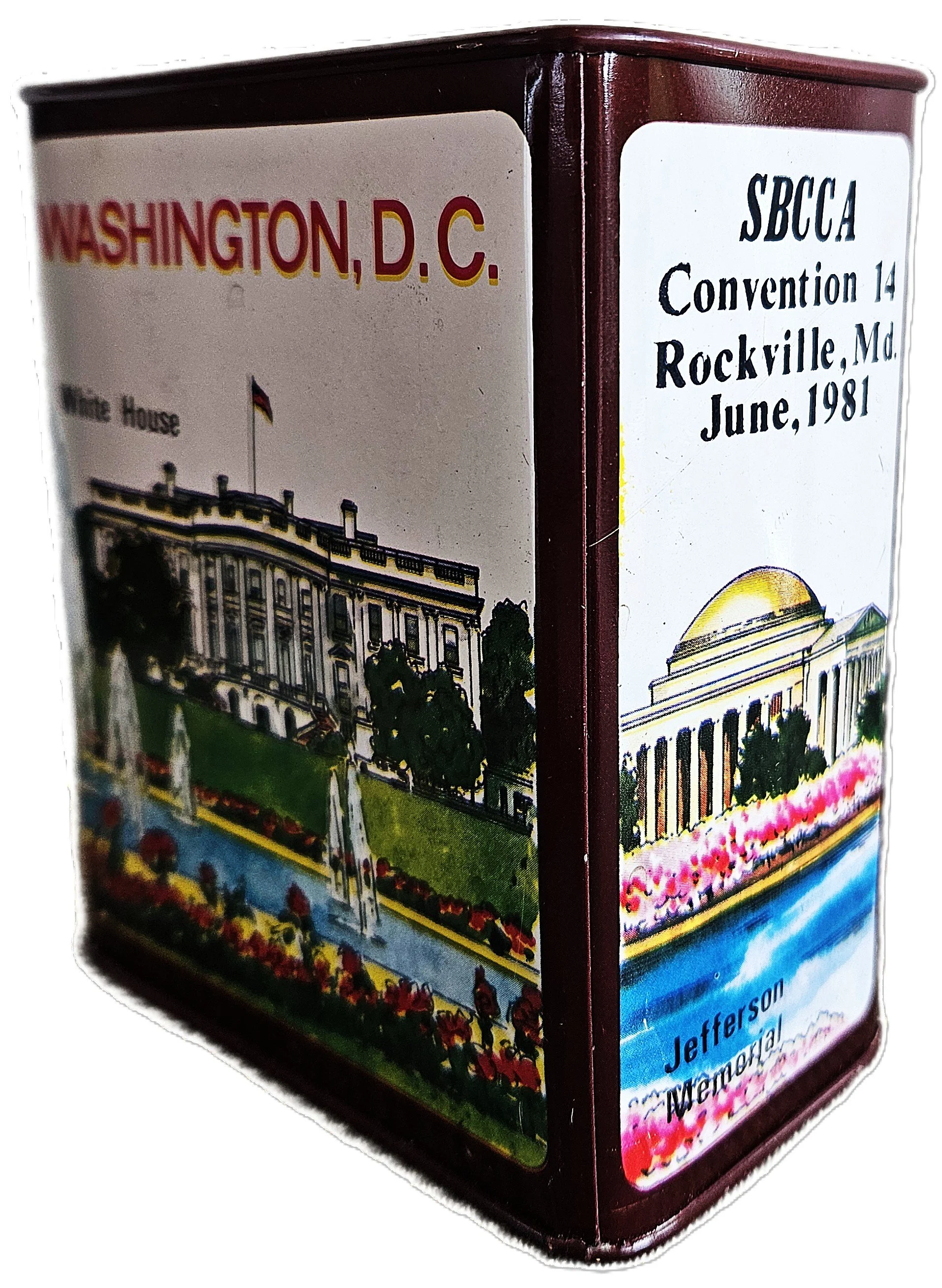
Washington Lithographed Bank
The multicolored tin lithographed rectangle bank depicted Washington, DC buildings. Measuring 5” high X 4” wide x 2 ½ “ deep, the coin slot is located at the top of the bank.
Convention Favors: Ballpoint pen, 6" ruler, place magnet, screwdriver key chain.
-
1982 - Convention #15
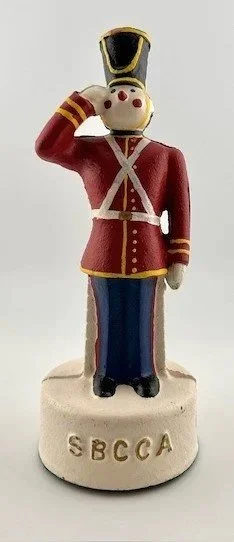
Toy Soldier
The Toy Soldier Bank was produced by the 1982 Special Projects Committee composed of Don Duer and Ed. The Project took a year, and like the 1976 Flags Bank effort, it went down to the wire to completion. Ed was painting banks just days before he brought a number of them to Hartford.
The idea for the bank was Eds, and it is a representation of a toy soldier familiar to many who have seen the wooden version which is not a bank. The pattern was made by Laverne A. Worley, the person who produced the Gettysburg Bank.
A total of 489 were made. The banks were painted them in six colors: black, white, gold, red, yellow and blue.
The Toy Soldier is 7-1/2" tall and made of cast iron.
At the Convention, members could purchase the first bank for $5.00; additional banks, after all who wanted them got them, cost $7.00.
The Toy Soldier bank is an exclusive SBCCA bank and the mold has been broken. See "At the Auction", (Penny Bank Post, August 1982) to learn how much two parts of it brought.
-
1983 - Convention #16
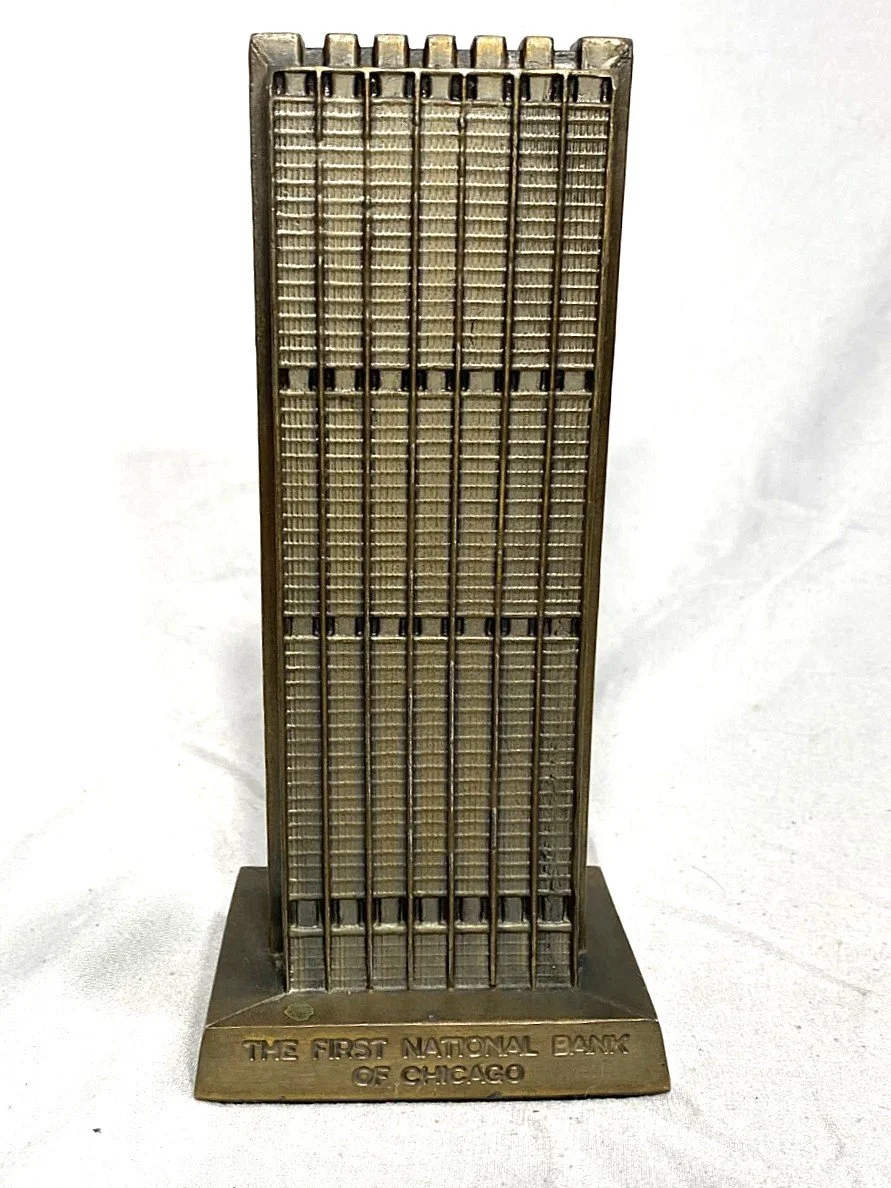
First National Bank of Chicago
The First National Bank of Chicago was produced using a slush mold. The bank materials consist of Zinc (95%) and aluminum (5%).
This limited edition Banthrico Bank was made in recoginition of the convention’s location in Chicago. In addition to the bank favor, club members were given the opportunity to tour the Banthrico Manufacturing Plan. At the conclusion of this visit, attendees received a brass-plated Poodle Bank (see Favors).
-
1986 - Convention #19
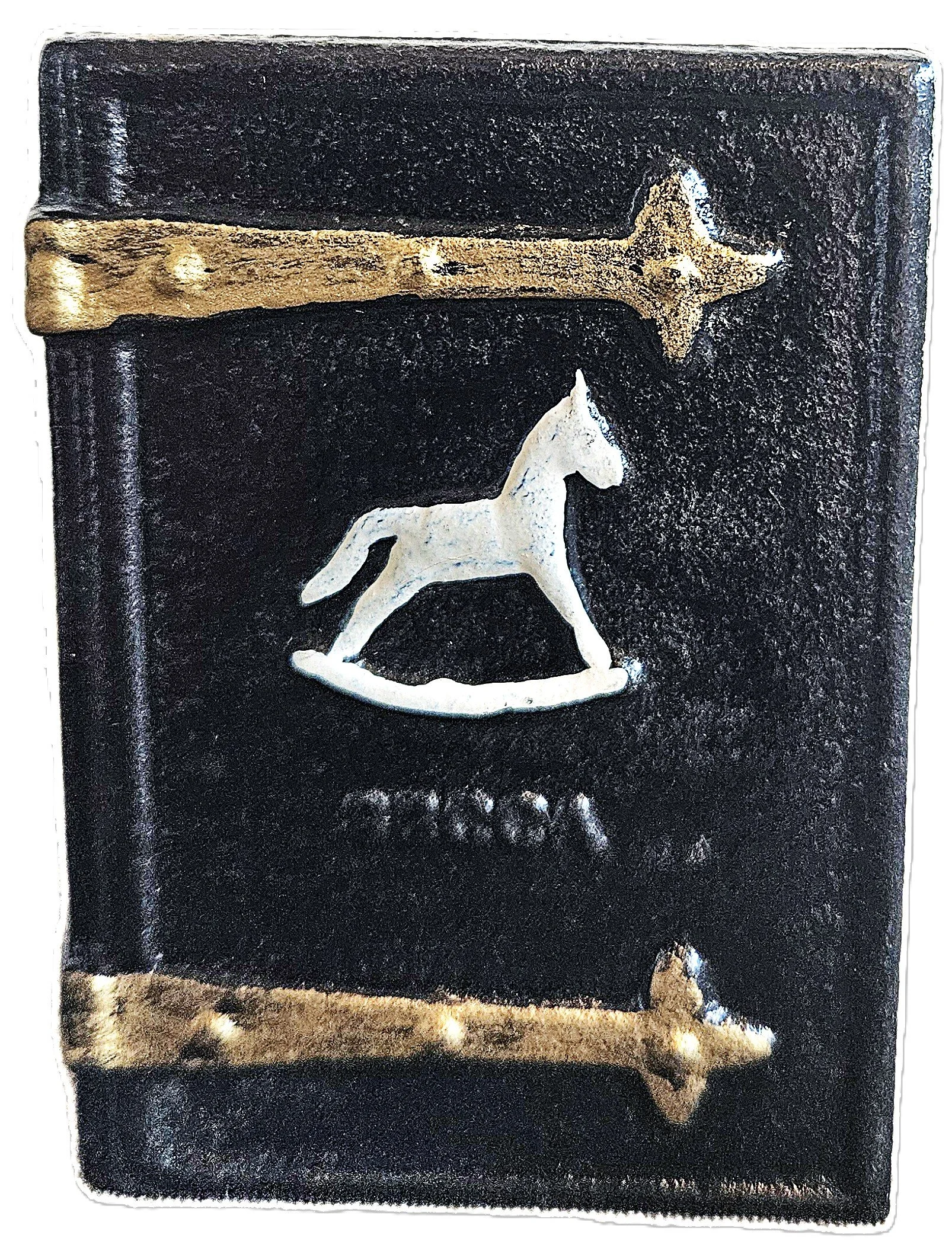
Book Bank
The club’s 20th anniversary bank was an unusual book bank. Arlene Smith had the idea to produce the bank and Don Duer translated her idea to a drawing that was then shared with Laverne Worley who carved the pattern. Bob Smith painted the bank.
Only 350 banks were ultimately cast. Painted in antique black with gilded hinges and pages, the bank is 3 ½ inches tall and 1” wide. The bank was cast in two parts held together by a screw.
-
1987 - Convention #20
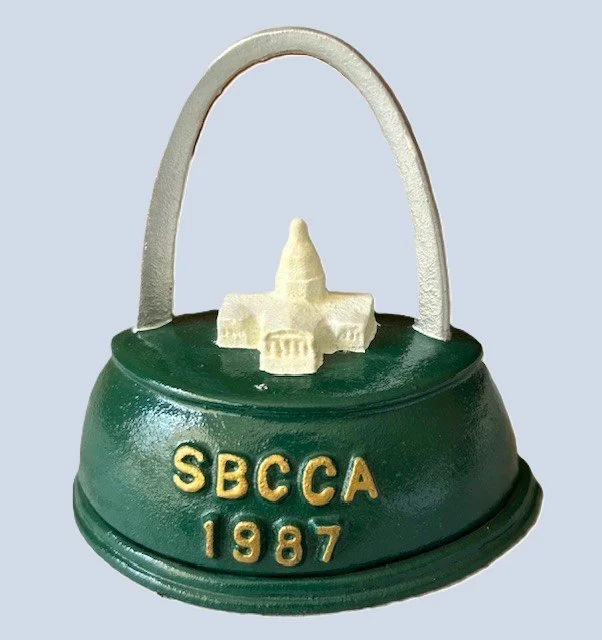
The Saint Louis Arch Bank
This cast iron bank was designed by Gordon Shroff. As was the case with other SBCCA banks, Laverne Worley was responsible for the bank pattern. The bank was assembled from three pieces and measures 4 ¼ high x 4 9/16 wide x 2 7/8 inches deep.
The oval shaped mound represents Mound City as St. Louis was once known. The arch depicts in miniature the tallest National Monument in the U.S., a 630-foot inverted stainless steel catenary curve designed by Eero Saarinen. Under the “Gateway Arch” is the Old Courthouse.
The Old Courthouse was the site of the Dred Scott decision (3/6/1857) which helped accelerate the coming Civil War. In that decision, Scott, a black man born into slavery, was judged not to be a citizen (having lived on “free soil” did not make him free). Called a “pawn in the national slavery controversy,” his new owner shortly thereafter set him free. He then worked as a porter in a St. Louis hotel and died the following year.
-
1988 - Convention #21
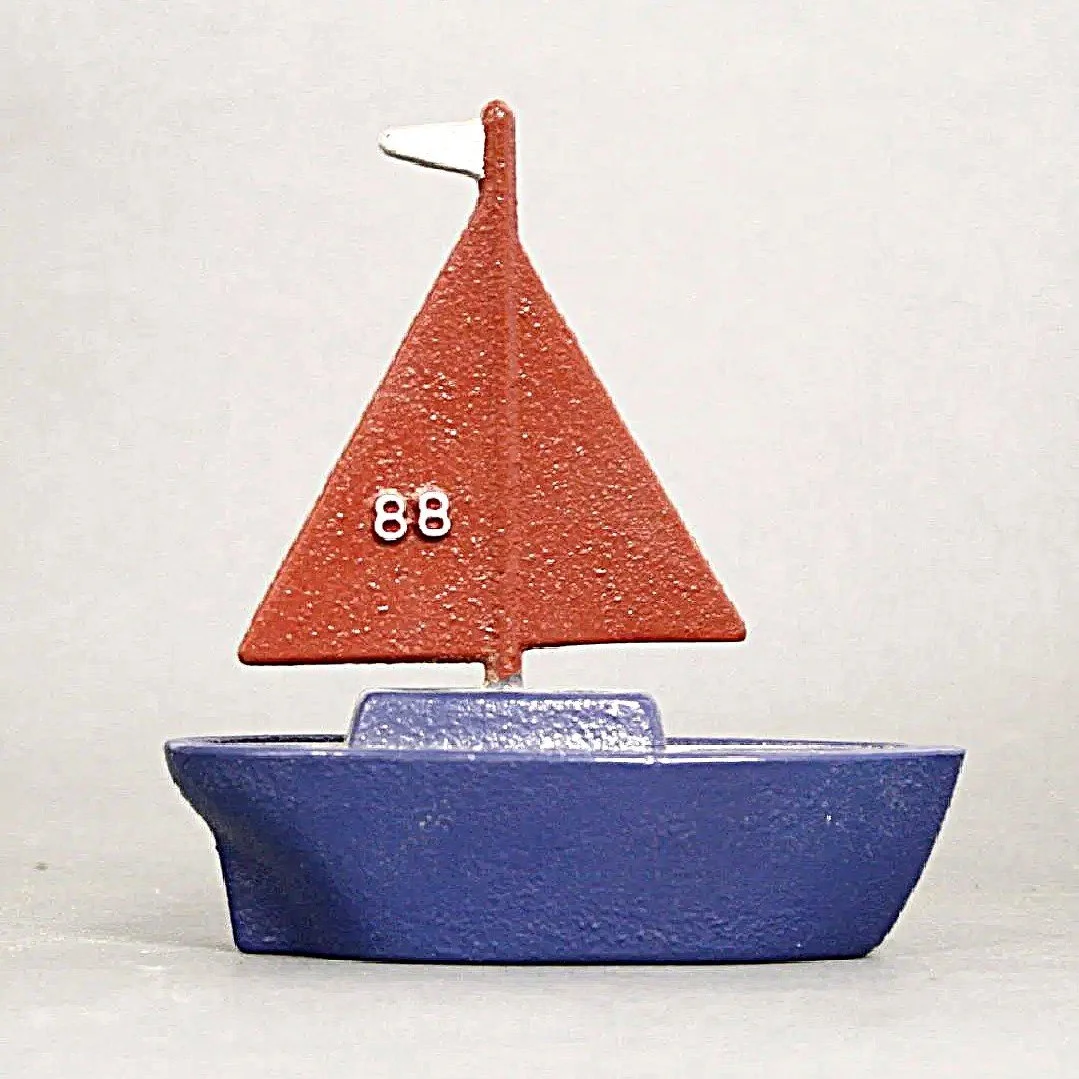
Sailboat Bank
The Finishing of the SBCCA 1988 Orlando Convention Bank
Early in 1987 Don Duer conceived the idea of a Sailboat Bank for the 1988 Convention in Orlando, Florida. From his design drawing, Harold Bucher, a local engineer and pattern maker, carved a beautiful mahogany pattern consisting of four pieces - the hull, deck, and two-part sail. The pattern was shipped to Laverne Worley in July 1987. Laverne made the master plates for a local foundry to use in casting the bank. The unfinished castings, partially assembled, arrived in Florida in 11 boxes in December 1987. Joe Knight and a personal friend, Bill Sutherland, volunteered to finish the banks. (See the process in the full PBP article.) This mammouth project of finishing approximately 500 banks took many hours of work. From the comments received at the Convention, we believe everyone was pleased with the final results pictured.
Members not attending the Convention may receive their bank by sending $4.00 for postage and packing to Arlaine Smith, 62 South Hazelwood, Newark, Ohio
Source: Duer, D. (1988). The finishing of the SBCCA 1988 Orlando convention bank. The Penny Bank Post, No. 1, 10–11.
-
1989 - Convention #22
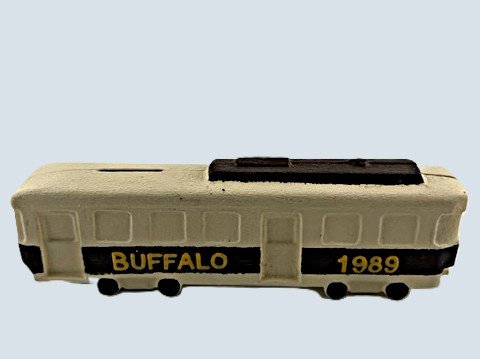
Trolley Bank
The Trolley Bank was patterned after the Niagara Frontier Transportation Authority Trolley. Laverne Worley created the pattern for the bank which was designed by Don Duer and assembled /painted by Carol Camillo.
-
1990 - Convention #23
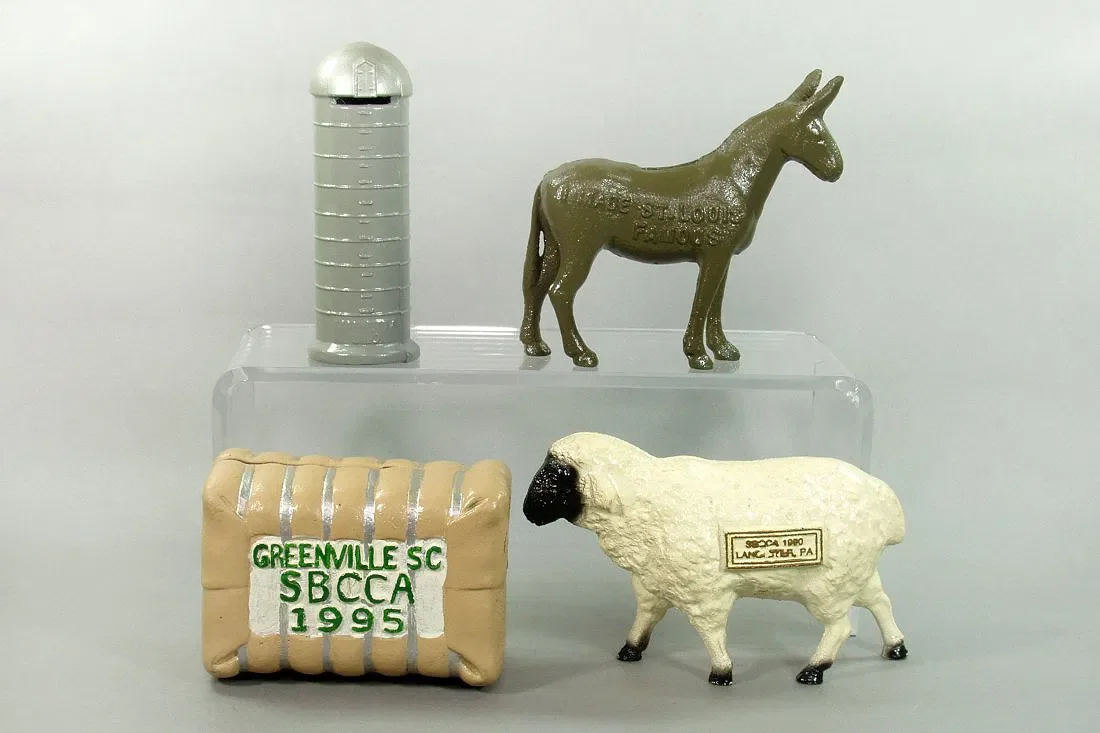
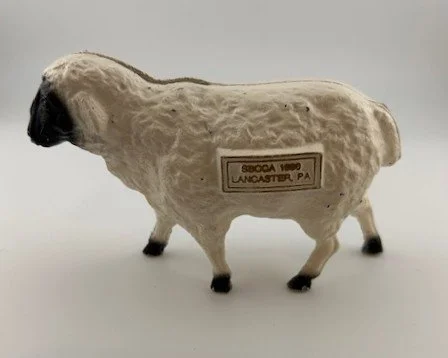
Sheep Bank
The Lancaster Sheep Bank was cast at John Wright Foundry.
-
1991 - Convention #24
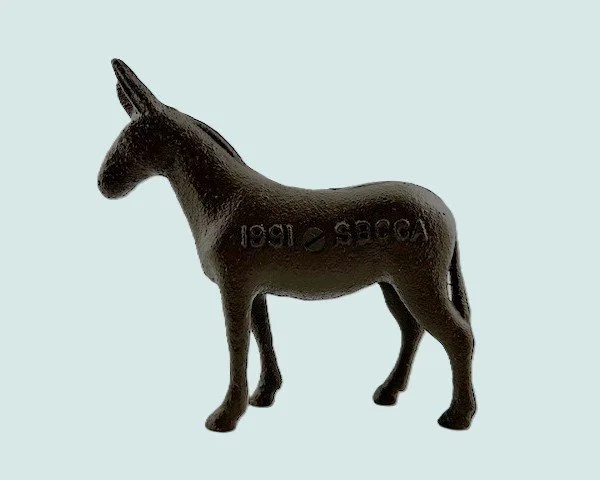
St. Louis Mule Bank
-
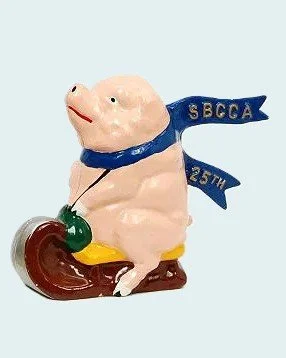
1992 - Convention #25
Pig on Sled Bank
-
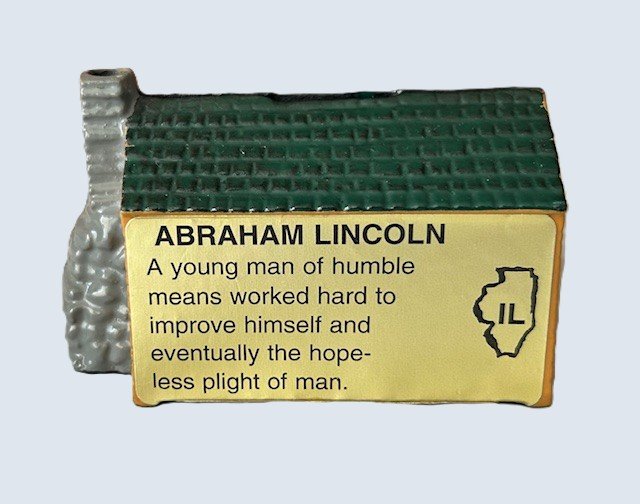
1993 - Convention #26
Abraham Lincoln’s Log Cabin
Cast iron log cabin bank with description attached.
-
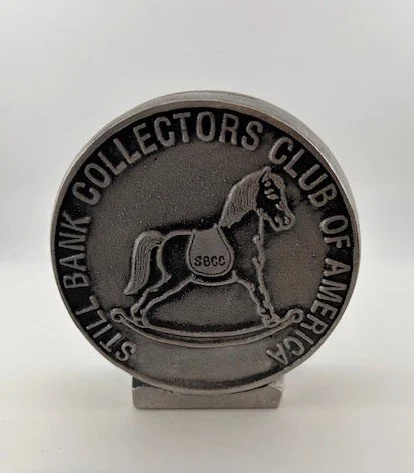
1994 -Convention #27
Circular bank with club logo and Reading Pagoda
Measuring 4 1/2” high and 1 3/8” deep, the 1994 convention bank celebrates both the club symbol and the Reading PA pagoda on the opposite side.
The bank is aluminum cast. Only 300 were produced.
-
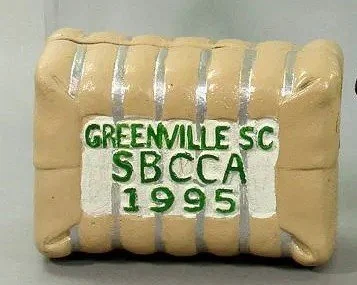
1995 Convention #28
Cotton Bale Bank
Measuring 4” long, 2 1/2” high, and 2 1/8” deep; the Cotton Bale Bank was produced in limited qualities.
The bank celebrates the importance of cotton production in the southern United States. Bales contain cotton fiber and are shipped to cotton compress warehouses where the fiber is compressed before being transported to mills where the fiber is spun into threads.
Learn More: Penny Bank Post, #2, 1995, P. 15
-
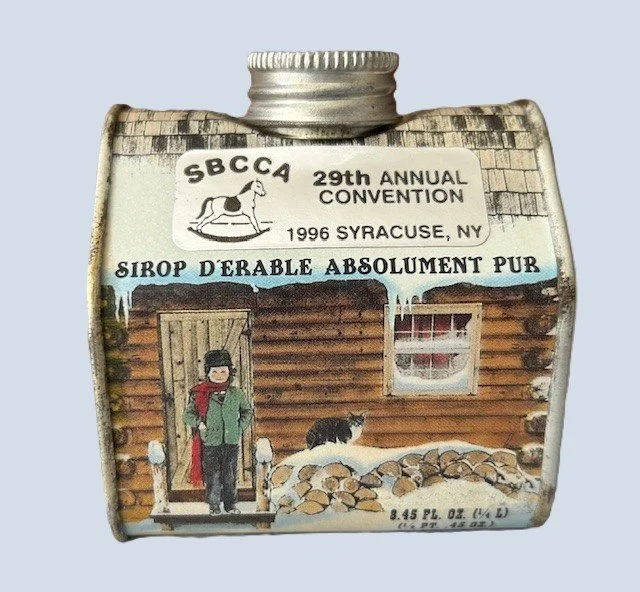
1996 - Convention #29
Maple Syrup Can
A colorful tin bank beautifully detailed on all sides. And yes, the bank did actually contain maple syrup! The can was produced by the New England Container Company in Swanton, Vermont.
The bottom of the bank reads: “The Indians Called It Sinzibukwud. The Indians taught the first white settlers how to tap maple trees in the spring, then evaporate the sweet sap until it became maple syrup.
In Ben Franklin’s time, plans were afoot to make America self-sufficient in sugar production, using maple sugar.
-
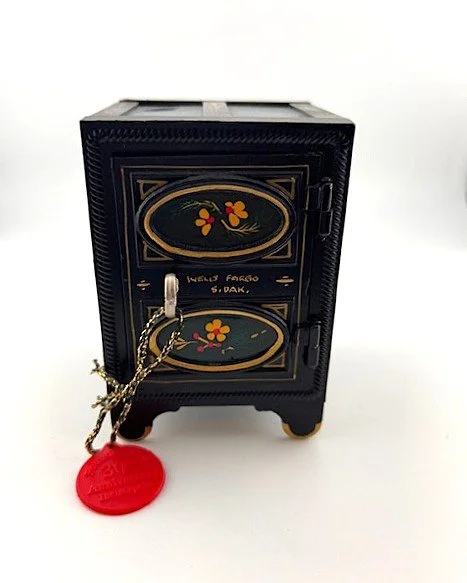
1997 - Convention #30
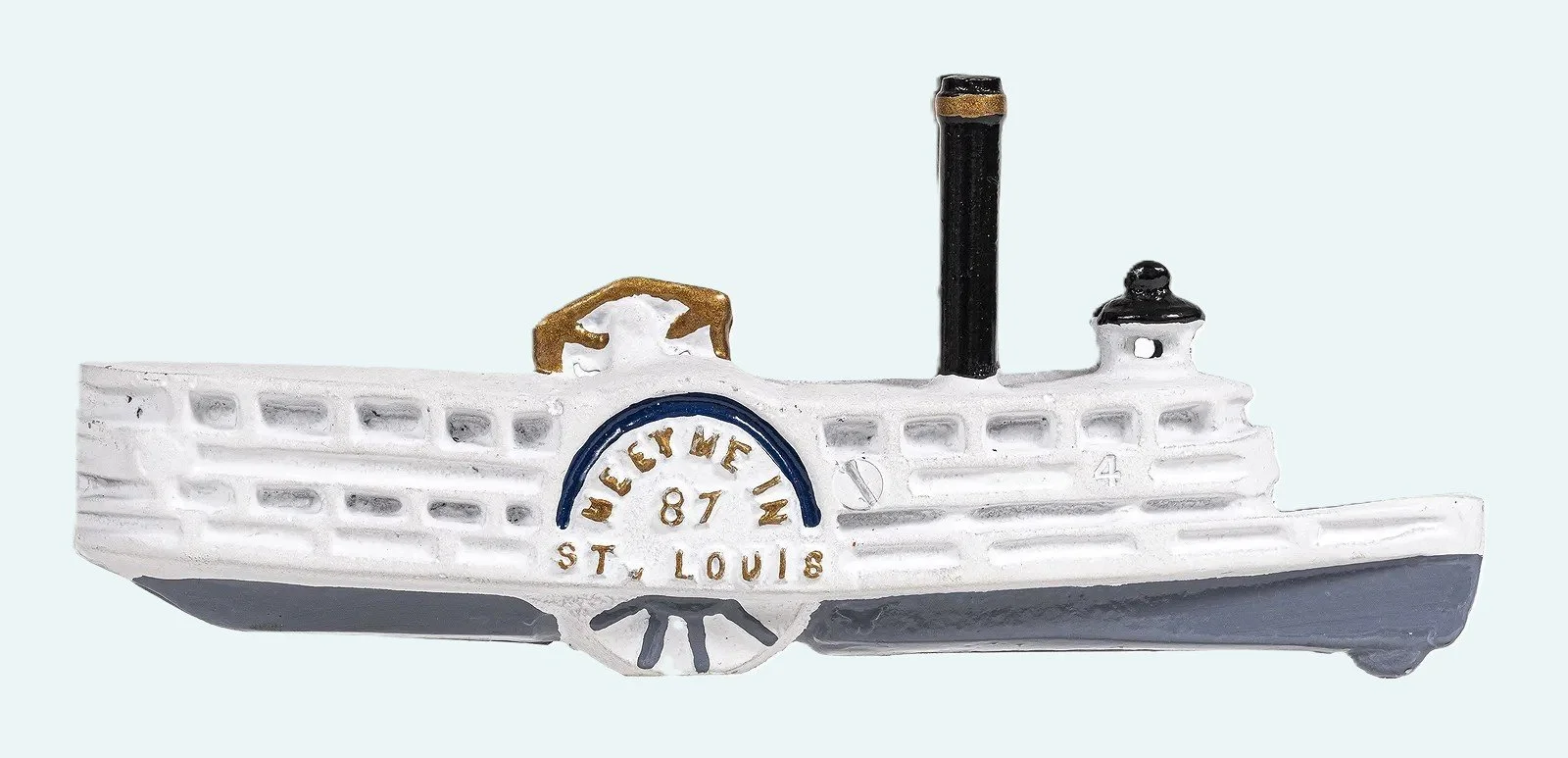
Rope and Oval Safe Bank
The design and production of our convention banks has never been without challenge. In the case of The Rope and Oval Safe Bank, Larry and Jeannie Egelhoff went well beyond the extra mile!
Banks were painted in dark green, maroon, dark blue or black. The rope design around the door of the bank was based upon an antique mirror and the key to the bank is unique to match the design of the bank (look on the bit of the key for Larry and Jeannie’s initials). Only 240 of these banks were produced.
Learn More: Penny Bank Post, Convention Issue, 1997, pp. 14-15.
Convention Favor: Guide to Recognizing Damage to Still Banks booklet
-
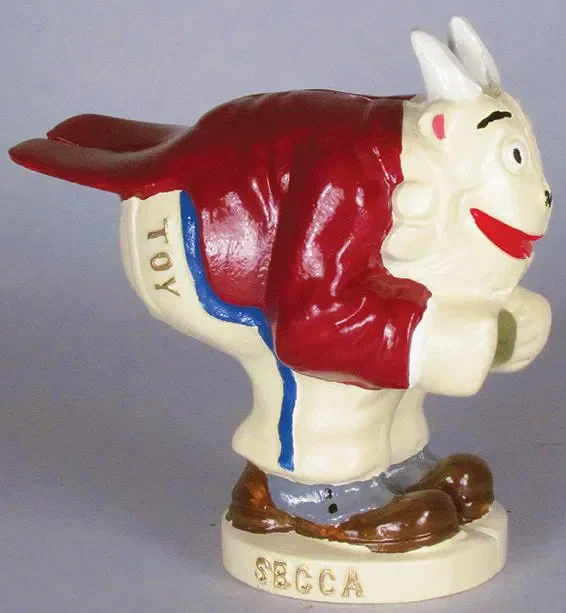
1998 - Convention #31
Kidd's Doc Yak Bank
The earlier of the two SBCCA Doc Yak banks, this bank was produced by Reynolds Toys but painted locally in Portland by the Kidds.
Old Doc Yak was a popular early American comic strip character created by cartoonist Sidney Smith that ran in the Chicago Tribune from 1912 to 1919. He was an anthropomorphic, cantankerous talking goat (or yak) who was a family man and was described as a "beauty specialist" or "fixer" for animals, often helping other animals solve absurd problems before focusing on his own domestic dilemmas.
-
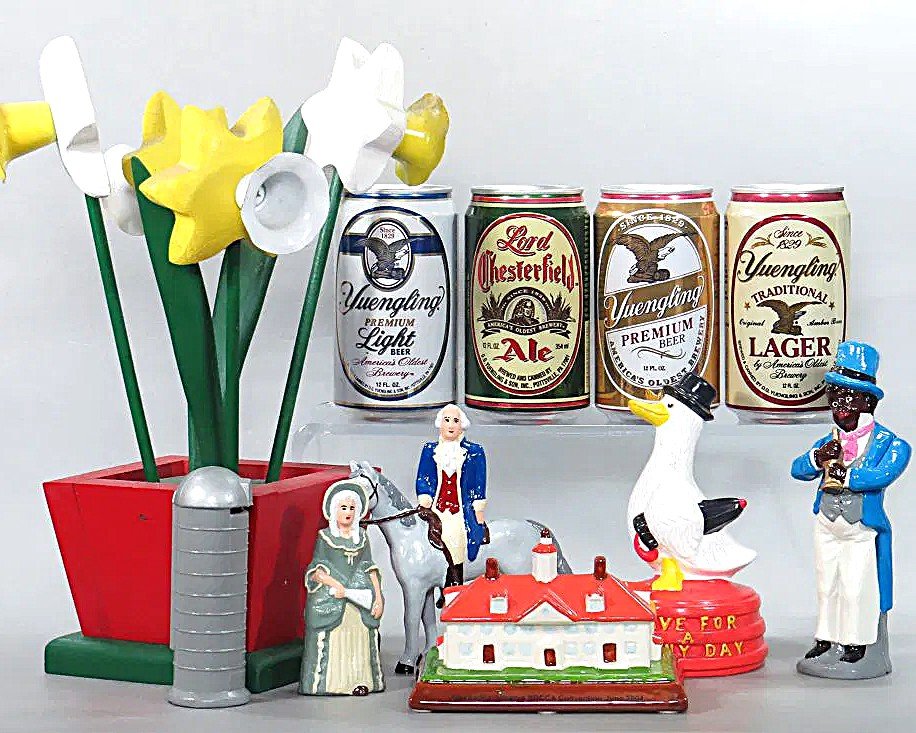
1999 - Convention #32
Yuengling Beer Can Banks
Distributed in sets of three, the Yuengling Beer Can Banks came in four different variations.
-
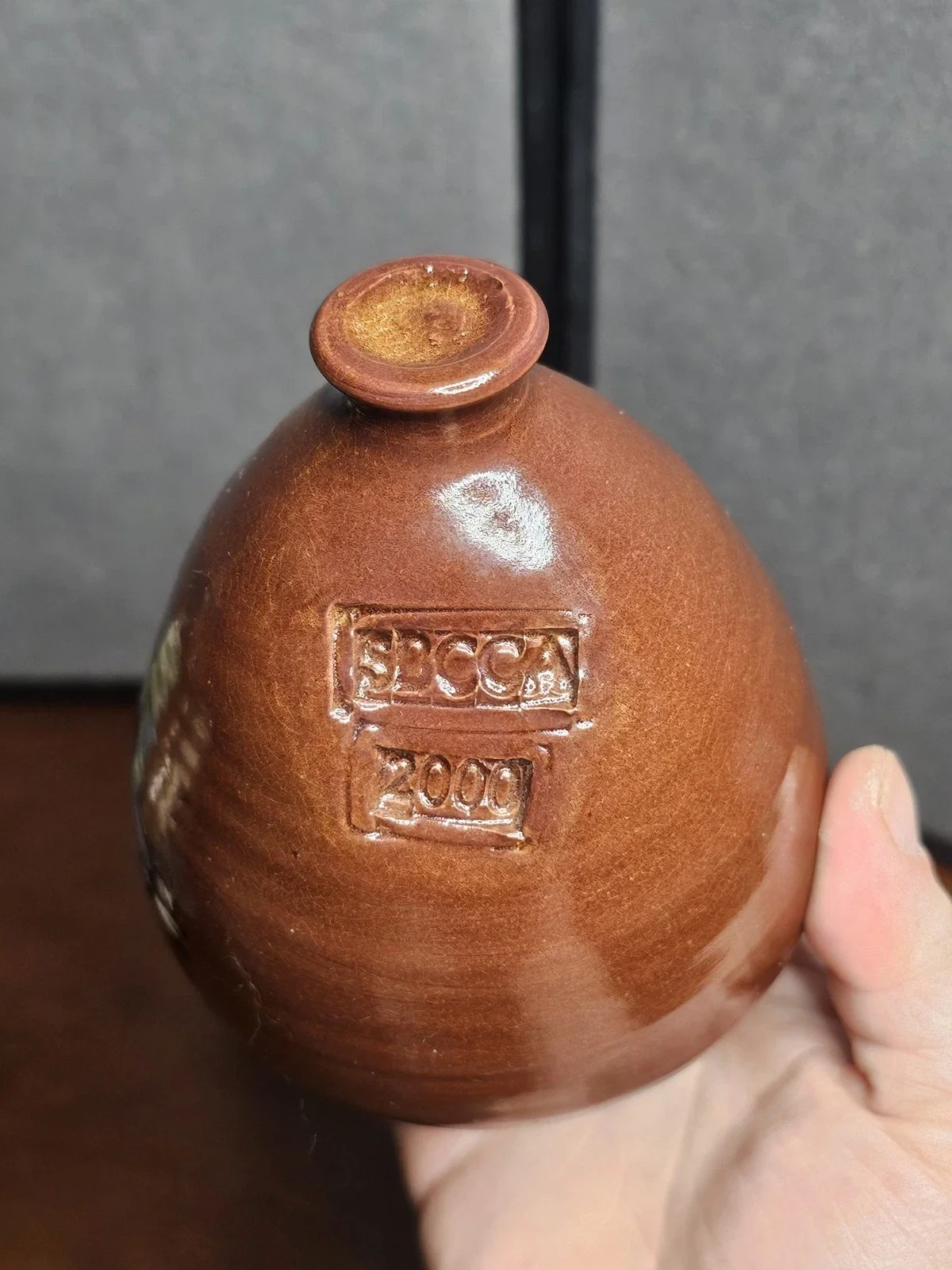
2000 - Convention #33
OSV Pottery Neck-Hanging Bank
This pottery bank was designed to be hung with a string or cord around ones neck in order to receive tips. Made on a pottery wheel, by hand, each bank is unique. The bank is signed OSV (Old Sturbridge Village) on the bottom.
Learn More: Penny Bank Post, September 2000, pp. 18-19.
-
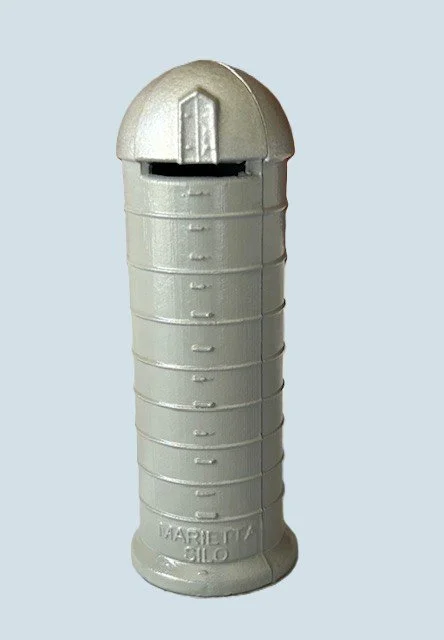
2002 - Convention #35
Small Marietta Silo
Using a lost wax casting process, the Marietta Silo Bank was designed by Larry Egelhoff and painted by Charles Meeks. Measuring 4 ½ inches tall this cast iron bank was painted gray with a silver top and was intended to compliment the larger famous Marietta Silo Bank,
-
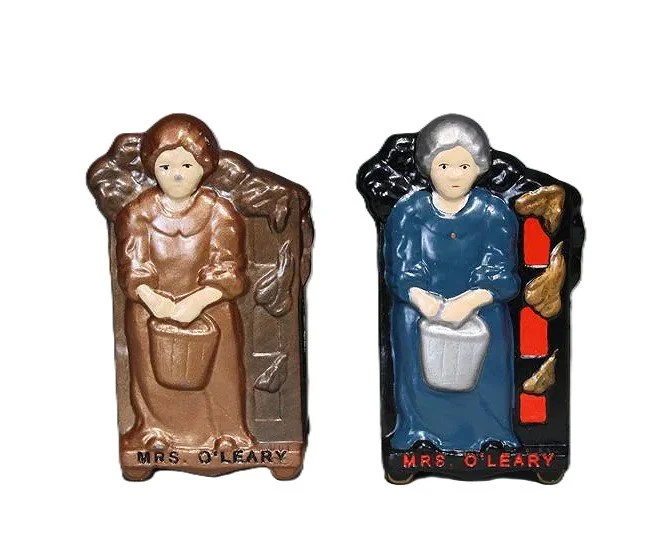
2003 - Convention #36
Mrs. O'Leary Bank
A Harper style safe bank designed and painted by Mike Henry and produced by Larry Egelhoff.
The cast iron bank measures 4 ½ inches tall. Color variations included blue and brown (bronze). One bank in white was produced and purchased at the club auction by Jim Redwine.
The bank tells the story of the Great Chicago Fire. “Flames shooting out of the windows, dark billowing smoke, and a not quite big enough bucket to do the job graces this bank.”
Learn more: Egelhoff, L. (2003) The Mrs. O’Leary Convention Bank, The Penny Bank Post, September, 12-13.
Still Bank Collectors Club of America - Minutes of the 36th Annual General Meeting (2003), The Penny Bank Post, September, 20.
-
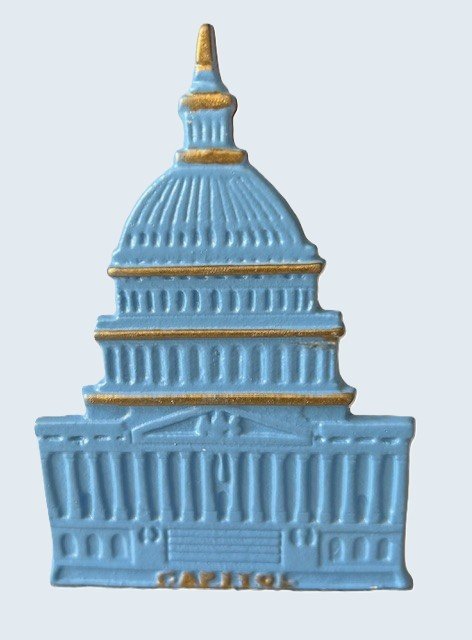
2004 - Convention #37
Capital Bank
Designed by Don Duer and painted by Jeanie Egelhoff, the cast iron Capital Building was produced in white, blue, and silver.
-
2005 - Convention #38
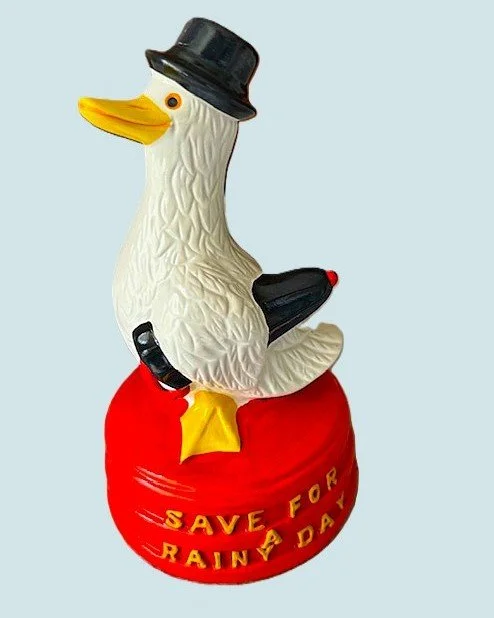
Rainy Day Duck
The Rainy Day Ceramic Duck is 5 7/8 inches tall. The bank was painted in six colors and was produced in Germany by Ulrike Riegraf-Blank.
Learn More: Riegraf-Blank, U. (2005, August). Rainy Day Duck – Manufacturing Process. The Penny Bank Post, 19–21.
-
2006 - Convention #39
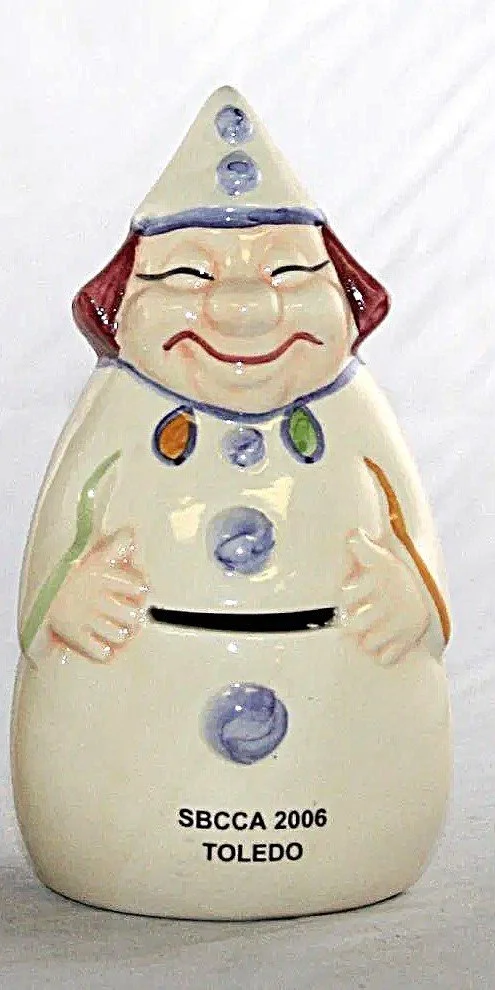
Two Faced Fellow Bank
This clever pottery bank illustrates the challenges the convention faced as it was relocated to Toledo from New Orleans due to Hurricane Katrina. The smiling side of this bank also reminded us to celebrate the club’s 40th Anniversary.
-

2007 - Convention #40
Kansas City Monarchs Baseball Player
The 2007 Convention Bank honors the Kansas City Monarchs baseball team. The history of the team is fascinating in its own right, as I learned the following from the Negro League Baseball Players Association website (www.nlbpa.com/kansas_city_ monarchs): “They were charter members of the Negro National League in 1920. Winners of more than a dozen league championships, the Monarch name became the Negro League’s answer to the New York Yankees. They won their first World Series title in 1924, defeating the Hillsdale Giants, from Philadelphia, in a thrilling ten game series.”
Some of black baseball’s best players wore the Monarch uniform. The Monarchs also sent the most players into Major League baseball after the color barrier was broken. Some of the players from this elite group included Jackie Robinson, Satchel Paige, Ernie Banks, Elston Howard, Hank Thompson and Willard “Home Run” Brown. The Monarchs were black baseball’s glamour franchise.”
The 2007 Convention Bank, designed by Ken Russell, was crafted in cast iron by fellow club member Larry Egelhoff. The casting shows excellent detail and is very nicely painted in period-correct colors. At the time extra examples were sold to members for $110.00. .
150 of these banks were produced in white/red and blue/gray colors. Two banks were nickeled and were originally owned by Larry Egelhoff and Ken Russell.
Source: Vicic, R. (2007) The 2007 Convention Bank. The Penny Bank Post, December, 5.
-
2008 - Convention #41
Sun Trust Building (Orlando, FL) Bank
Our 2008 Convention Bank is a replica of the Sun Trust Building, which is visible from one of the freeways in Orlando. At 5 1/2" tall, this beefy casting with its fine detail will appeal to still bank collectors and souvenir building collectors alike. It is colorful and will do well as a bank and/or as a paperweight on your desk. Coin slot is in the bottom. At the time extra examples were sold to members for $75.00.
Produced by InFocusTech. Only 150 were produced.
Source: Vivic, R. (2008). SBCCA 2008 Convention Bank . The Penny Bank Post, August, 7.
-
2009 - Convention #42
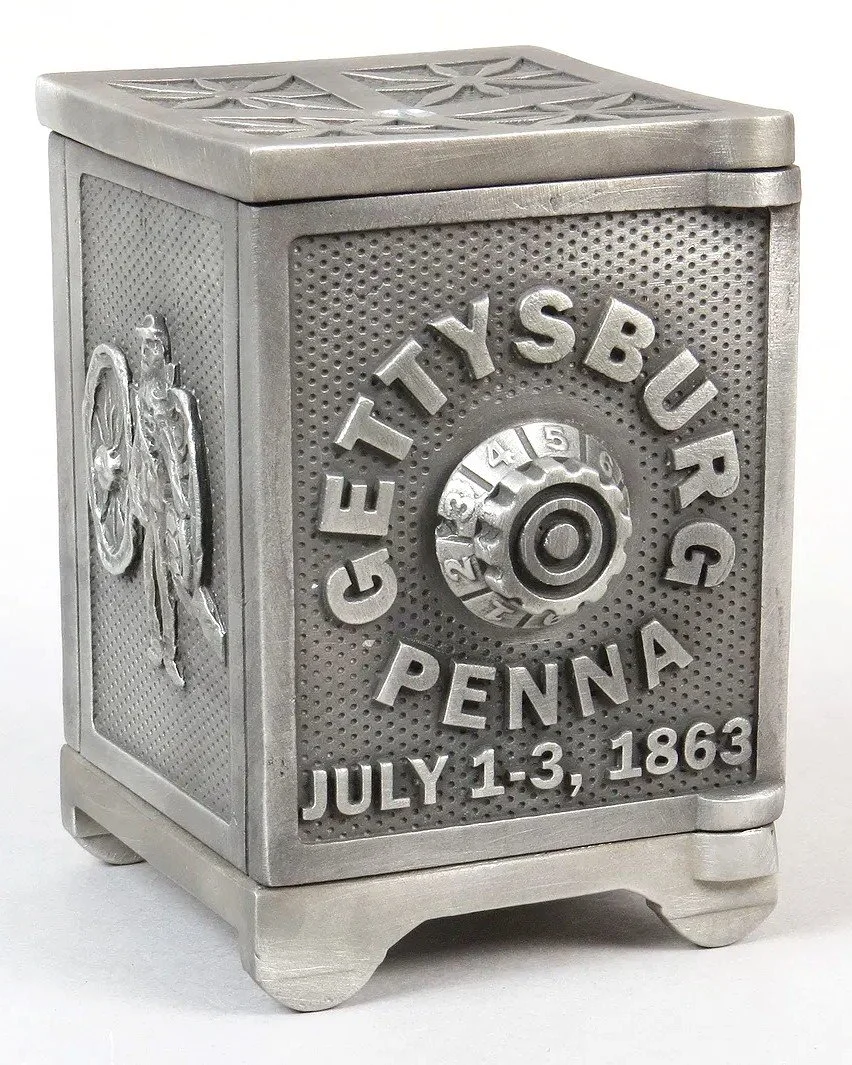
Gettysburg Safe Bank
Designed by Mike Holz and modeled by Mike Merwine at InFocusTech this bank was patterned after the popular advertising safe banks made by the Regent Mfg Company of Chicago in the late 1890s.
This heavy white metal safe bank measures 4 inches tall. Note the combination dial is a “dummy” and does not function as a lock. The bank features the inscription “Gettysburg Penna Jul 1-3, 1863.”
Only 125 were produced by InFocusTech, Inc. and made exclusively for the SBCCA Convention.
-
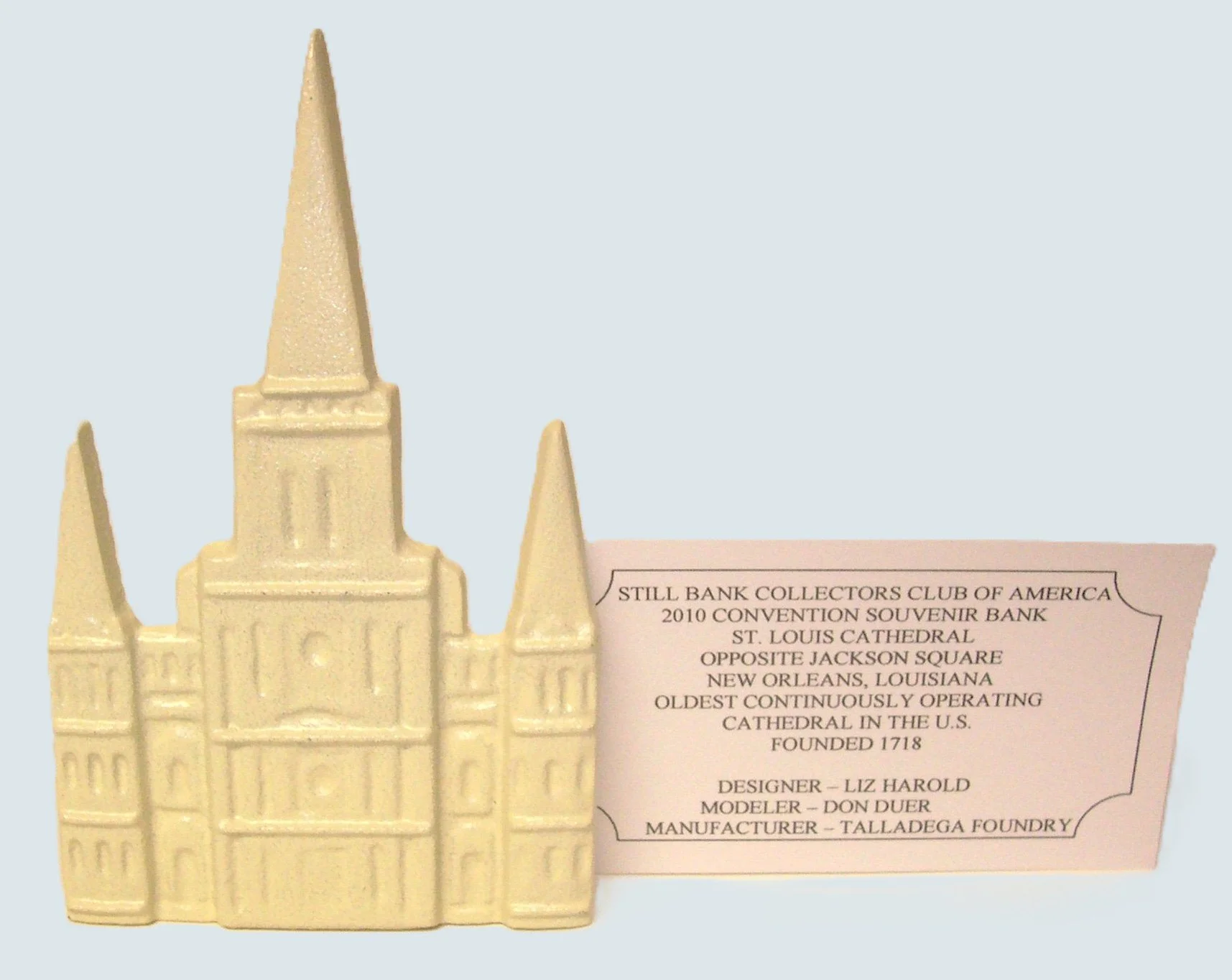
2010 - Convention #43
St. Louis Cathedral (New Orleans, LA) Bank
Designed by Liz Harold and modeled by Don Duer, the 2010 convention bank measures 6 ½ inches tall.
Manufactured by the Talladega Foundry, this replica of the St. Louis Cathedral commemorates the oldest continuously operating cathedral in the United States. The cathedral sits opposite Jackson Square in New Orleans, LA. The bank design reflects the cathedral’s distinctive French Colonial influenced form, typically featuring the central façade with its twin towers, arched windows, and classical symmetry.
-
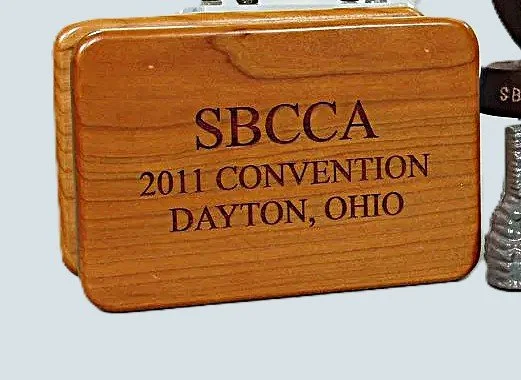
2011 - Convention #44
Cherrywood Bank Box
Designed by Elliotte Harold, this bank reflects a departure from traditional figural or cast-metal still banks, instead embracing a cabinet-style presentation rooted in both functionality and display aesthetics.
The bank is constructed of polished cherrywood, emphasizing natural grain and craftsmanship. Its form resembles a secure coin box. The design highlights precision woodworking, clean lines, and a subdued elegance.
As a limited production tied directly to the 2011 convention, the Cherrywood Bank Box holds particular appeal among collectors for its distinct material, maker attribution, and its representation of modern craftsmanship within the still bank tradition.
Manufactured by Total Engraving of Smethport, PA.
Each bank was hand made and individually engraved. Measuring 4” by 6” only 100 were produced.
-
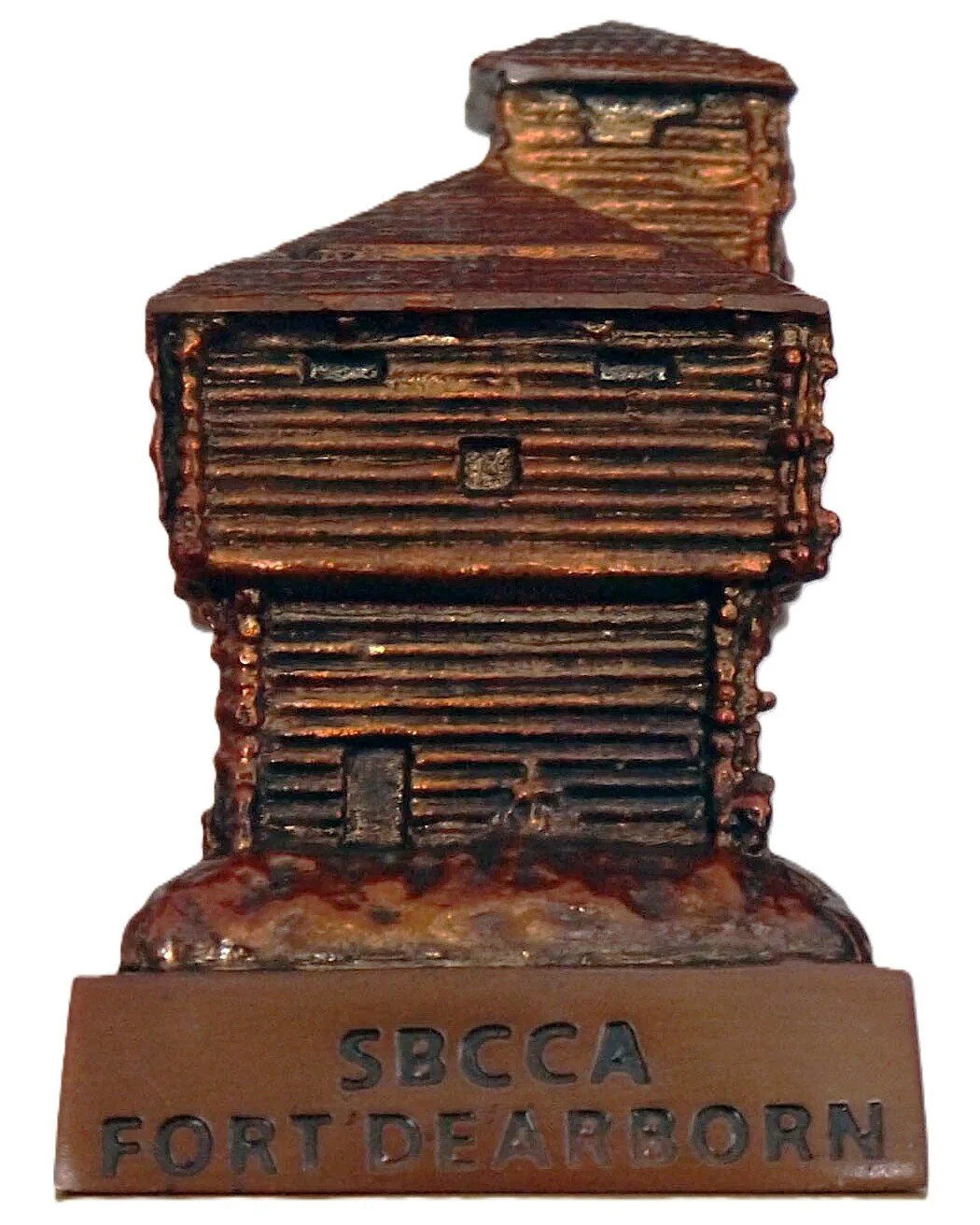
2013 Convention #46
Fort Dearborn Blockhouse Bank
The Fort Dearborn Blockhouse SBCCA Bank was selected as the official convention bank for the Schaumburg, Illinois meeting, reflecting the club’s ongoing tradition of issuing historically inspired banks tied to the host region or its cultural heritage.
The blockhouse traces its origins to Fort Dearborn, first constructed in 1803 at the mouth of the Chicago River to protect American interests on the frontier. The original fort was destroyed during the Battle of Fort Dearborn in the opening phase of the War of 1812, then rebuilt in 1816. The blockhouse associated with this second fort became an enduring symbol of early Chicago, representing both frontier defense and the broader tensions between U.S. forces, settlers, and Native American communities during westward expansion.
Although the original structure did not survive intact, a reconstructed version based on historical records has been preserved and relocated several times as Chicago developed.
The bank itself is modeled after the historic blockhouse emphasizing early American frontier architecture. The design features the characteristic square footprint, log-style construction, and projecting upper story seen in traditional blockhouses—elements intended to evoke defensive strength and period authenticity. As with many SBCCA convention issues, the Fort Dearborn Blockhouse bank was produced in limited quantities, making it both a collectible artifact and a tribute to Chicago’s early history, particularly the role of Fort Dearborn as a frontier military outpost established in 1803.
-
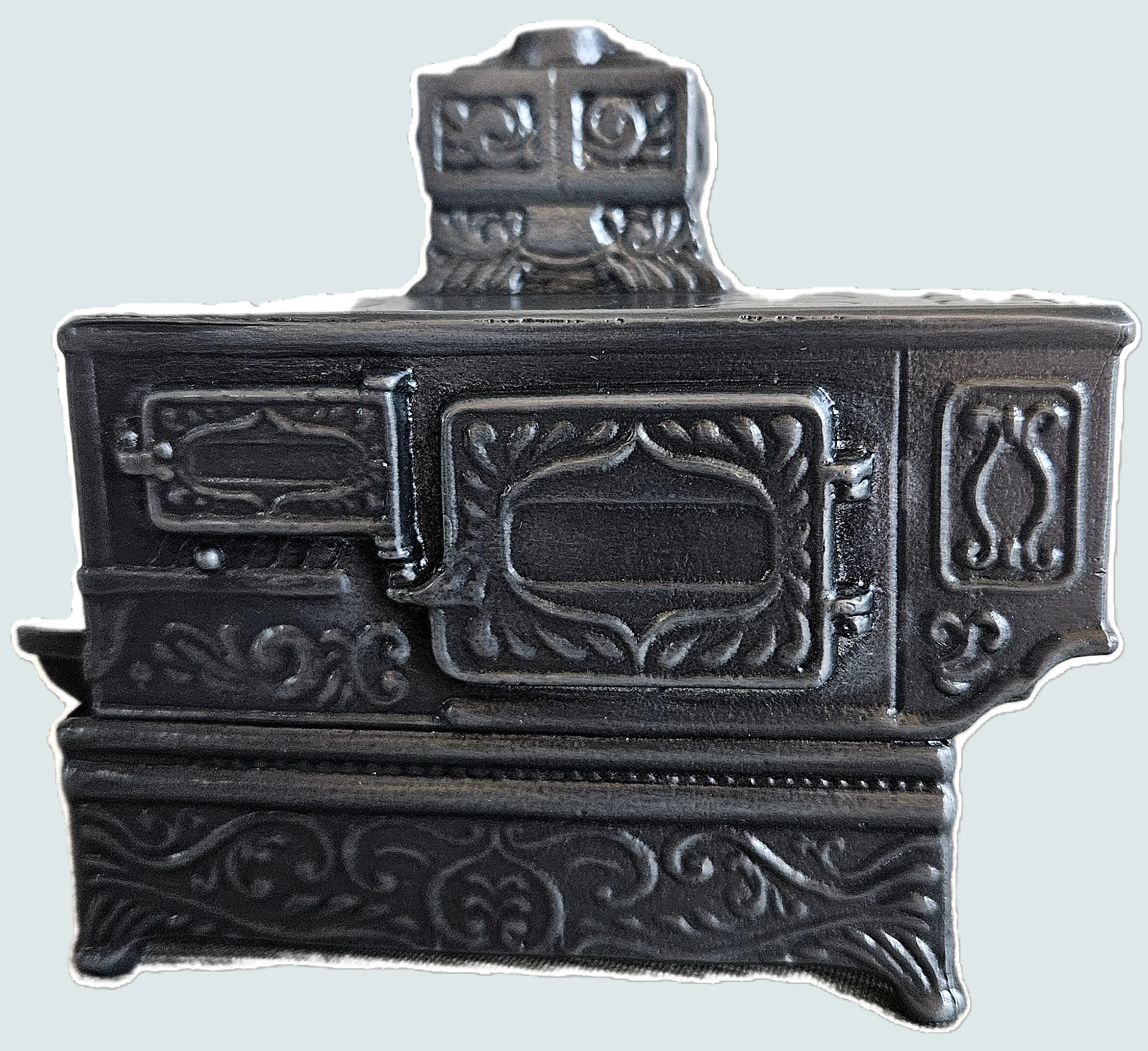
2014 - Convention #47
Michigan Stove Bank
Our SBCCA Michigan Stove Bank carefully reproduces the 19th century cast-iron banks that were used as promotional pieces for the Michigan Stove Company of Detroit. These banks combined function, advertising, and craftsmanship. Both the SBCCA bank and the original banks were designed in the form of miniature “Home Comfort” stoves. By replicating the appearance and decorative detail of the company’s full-size cast-iron stoves, the bank builds brand recognition while appealing to both children and adults.
Founded in 1864 in Detroit, the Michigan Stove Company became one of the largest stove manufacturers in the world, producing cast-iron heating and cooking stoves that were distributed nationwide. Its products were especially significant at a time when reliable home heating and efficient cooking technology were essential to daily life. The company’s “Home Comfort” line became widely recognized, reflecting both technological improvement and the growing expectation of comfort and convenience in American households.
-
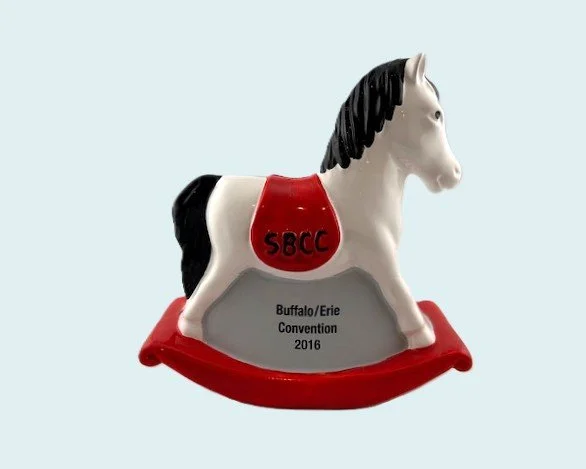
2016 - Convention #49
50th Anniversary Rocking Horse Bank
-
2017 - Convention #50
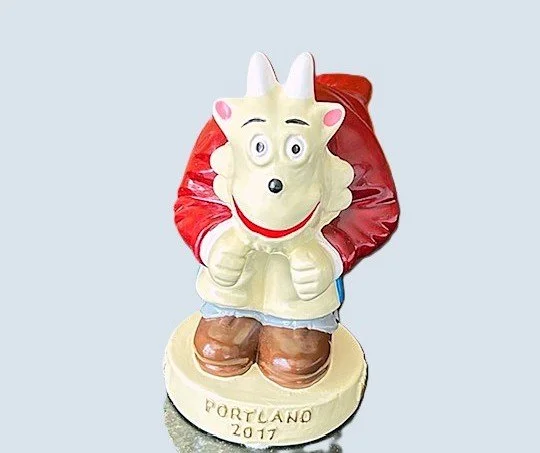
Ceramic Doc Yak
This ceramic bank mirrors the 1998 Kidd’s Doc Yak convention bank that was made in aluminum. The bank was designed and produced in Germany by Ulrike Riegraf-Blank. The base of the bank identifies the convention location and year (Portland 2017).
Beyond the comic pages, Old Doc Yak represented one of the earlier examples of character-based merchandising in the United States. Its appearance on products such as banks produced by the Arcade Company illustrated how popular media figures were leveraged to promote consumer goods—an approach that would later become standard in American marketing. In this way, Old Doc Yak stands at the intersection of entertainment, industry, and commerce, helping to establish patterns of character licensing and brand extension that continue to influence American culture today.
-
2018 - Convention #51
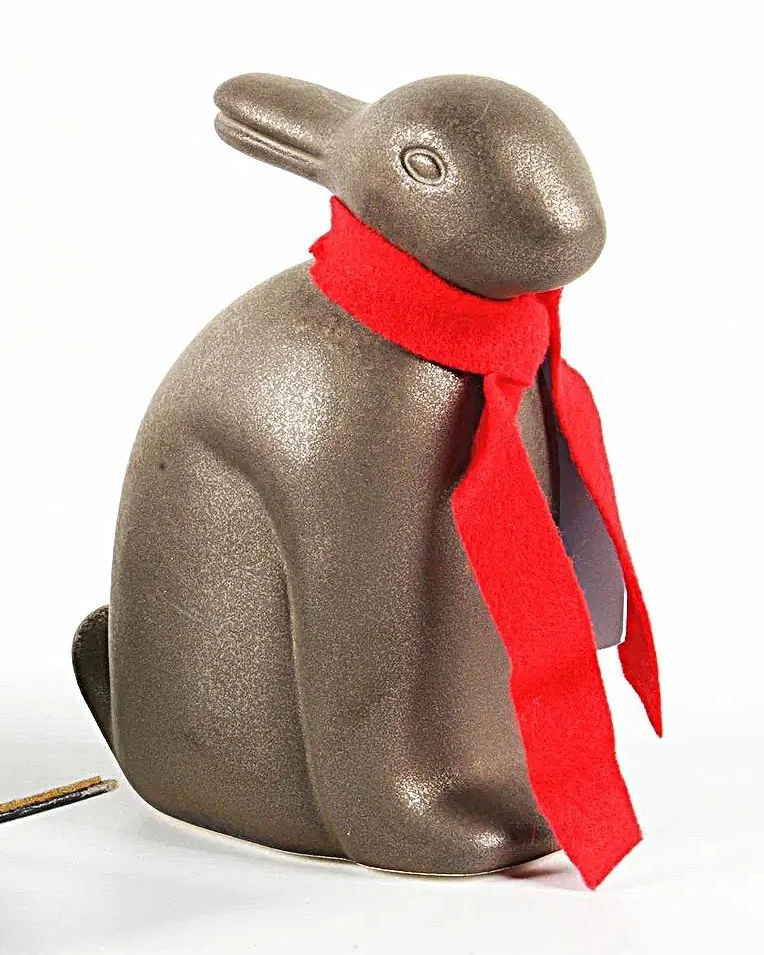
Duck or Rabbit Bank (In Honor of Ralph Dye)
The design of the 2018 convention bank was created in honor of longtime collector and influential club member Ralph Dye, whose contributions to the study and appreciation of still banks spanned decades. The selection of a dual-form “duck or rabbit” motif reflects both a playful visual concept—where the figure can be interpreted as either animal depending on perspective—and a nod to Dye’s appreciation for unusual and thought-provoking bank designs.
The bank itself typically follows the tradition of SBCCA convention issues: a limited-production collectible combining artistic interpretation with historical or thematic significance. The sculptural form emphasizes smooth contours and a compact, figural shape, allowing the piece to function both as a coin bank and a display object. As a tribute issue, the Duck or Rabbit bank carries added meaning within the collecting community, representing not only the 51st convention but also honoring Ralph Dye’s legacy as a respected scholar, presenter, and enthusiast whose influence helped shape modern still bank collecting.
Learn More: Meeks, C. (2018). SBCCA CONVENTION BANK 2018 Marietta, Ohio. The Penny Bank Post, August, 5.
-
2019 - Convention #52
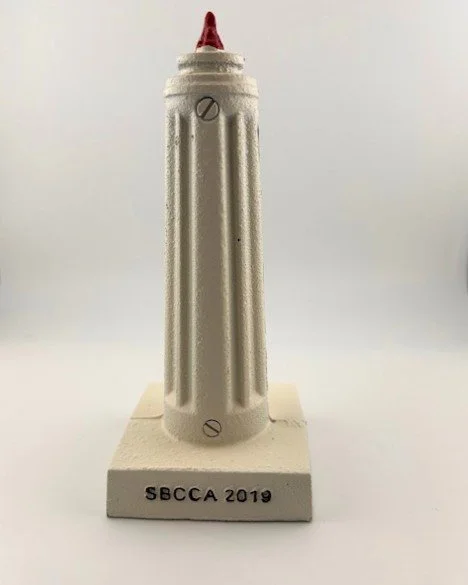
Liberty Memorial Tower Bank
Celebrating the actual Liberty Memorial Tower, the Liberty Memorial Tower Bank is 7” tall and 3” square (at bottom). The bank was produced in white (ivory), gold and gray all featuring back trim.
The Liberty Memorial Tower was designed by Harold Van Buren Magonigle. Rising 217 above the main courtyard and 268 feet above the North Lawn of Penn Valley Park in Kansas City, MO, the Memorial was dedicated “in honor of those who served in World War One in defense of liberty and our country.” It remains today as this nation’s only major memorial and museum specializing in the Great War of 1914-1918.
-
2020 - No Convention
COVID
-
2021 - Convention #53
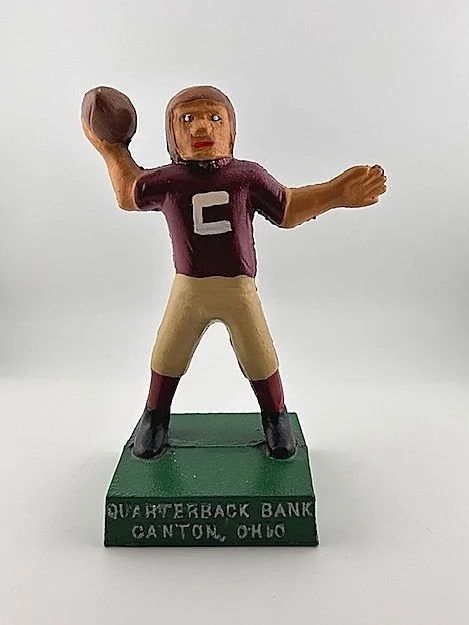
Quarterback Bank
Based upon a photo of Jim Thorpe, the Canton Football Bank was designed by Jim Russell. Only 105 of these banks were produced with one featuring Guy Williams name on the side panel of the bank. The front panel of the bank features the words Quarterback Bank Canton, Ohio.
James Thorpe was an American athlete who won Olympic gold medals and played professional football, baseball, and basketball. A citizen of the Sac and Fox Nation, he was the first Native American to win a gold medal for the United States in the Olympics. Considered one of the most versatile athletes of modern sports, Thorpe won two Olympic gold medals in the 1912 Summer Olympics (one in classic pentathlon and the other in decathlon).
Thorpe lost his Olympic titles after it was found he had been paid for playing two seasons of semi-professional baseball before competing in the Olympics, thus violating the contemporary amateurism rules. In 1983, 30 years after his death, the International Olympic Committee (IOC) restored Thorpe's Olympic medals with replicas, after ruling that the decision to strip him of his medals fell outside of the required 30 days. Official IOC records still listed Thorpe as co-champion in decathlon and pentathlon until 2022, when it was decided to restore him as the sole champion in both events.
-
2022 Convention #54
Banks No Longer Offered as Part of National Conventions.
-
2025 - Convention #57
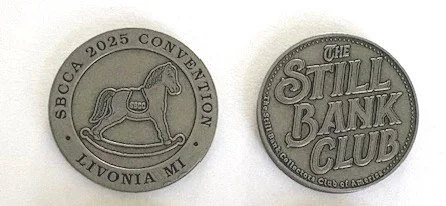
Challenge Coin
Challenge coins are small, custom-minted medallions that signify membership, achievement, or affiliation within a specific organization. Most commonly associated with the military, these coins are typically carried by service members and presented to recognize excellence, commemorate events, or reinforce unit identity and pride. They often feature insignias, mottos, or symbolic imagery unique to a unit, institution, or organization. Beyond the armed forces, challenge coins are now widely used by law enforcement agencies, fire departments, corporations, and nonprofit groups as a tangible expression of recognition and shared purpose.
The origins of challenge coins are most frequently traced to World War I, when a young American pilot reportedly carried a custom coin from his squadron that later helped identify him after being captured behind enemy lines. While elements of the story vary, the tradition gained broader prominence during the Vietnam War, when coins were used informally to establish credibility and camaraderie among service members. Over time, the “challenge” aspect—where individuals prove their membership by producing their coin—became part of the culture. Today, challenge coins serve both ceremonial and practical roles, linking modern organizations to a longstanding tradition of honor, belonging, and recognition.
The Club’s First Challenge Coin was designed by Bob Arp.
-
2026 - Convention # 58
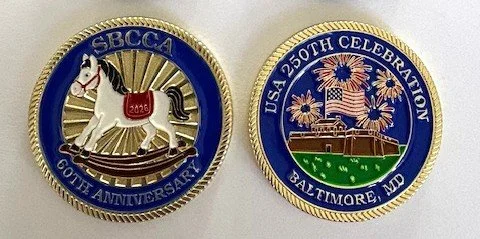
A Year of Celebration
The 2026 Challenge Coin recognizes the club’s 60th anniversary and the nation’s 250th celebration of liberty. The reverse side of the coin portrays Fort McHenry. This fort successfully defended Baltimore against a major British naval attack during the Battle of Baltimore in September 1814. Over the course of a 25-hour bombardment, British forces attempted to force the surrender of the fort, but American troops held their ground. When the smoke cleared, a large American flag was still flying over the fort, signaling that Baltimore had not fallen.
This moment directly inspired Francis Scott Key, who had witnessed the bombardment from a British ship, to write the poem “Defence of Fort M’Henry.” His words were later set to music and became “The Star-Spangled Banner,” which was officially adopted as the national anthem of the United States in 1931.
Designed by Bill Miller and Catherine Cook, only 150 of these challenge coins were produced.
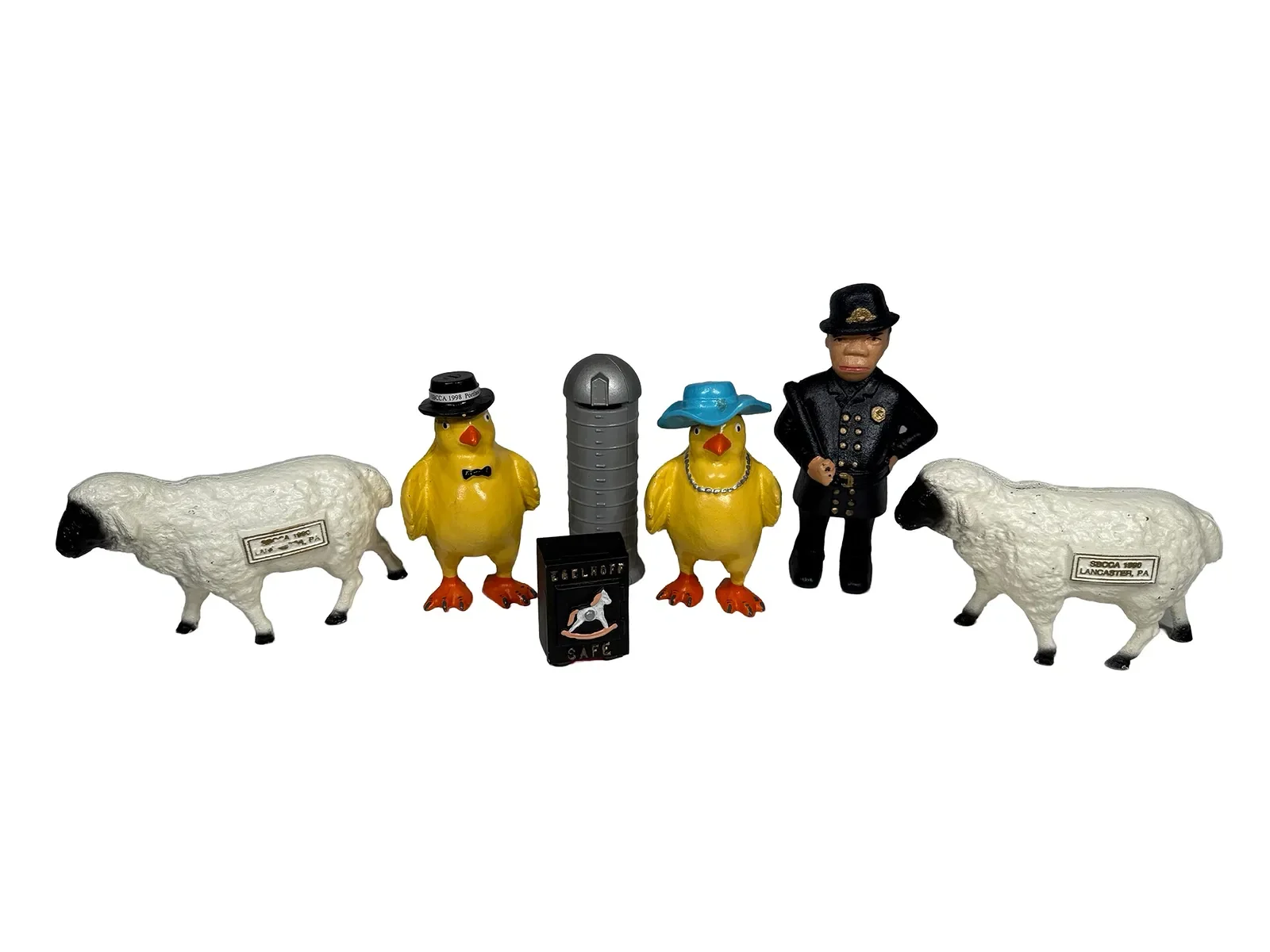
Convention Favors
-
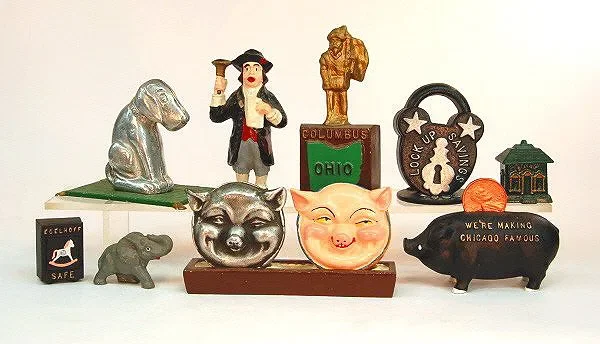
Reynolds Banks as Convention Favors
Reynolds Toy Company, commonly known as Reynolds Toys, was established by Charles V. “Charlie” Reynolds of Falls Church, Virginia. Reynolds was not originally a commercial toy manufacturer, but rather a highly respected collector and student of mechanical and still banks. His involvement with organizations such as the Mechanical Bank Collectors of America (MBCA) and the Still Bank Collectors Club of America (SBCCA) placed him at the center of the hobby during a period when interest in antique banks was growing and original examples were becoming increasingly scarce.
The company developed in the late twentieth century, primarily during the 1980s and 1990s. At that time, collectors faced limited access to original nineteenth-century mechanical banks, many of which had become prohibitively expensive. Reynolds responded by producing high-quality cast iron reproductions that closely followed the form and function of antique examples. These were not mass-produced items, but carefully cast and hand-finished pieces intended for collectors who valued both accuracy and craftsmanship. The mechanical actions were functional, allowing the banks to operate in the same manner as their nineteenth-century counterparts.
As his reputation grew, Reynolds expanded beyond reproduction work and became closely associated with collector organizations. He produced limited-edition banks for MBCA and SBCCA conventions, often in small runs tied to specific events. These convention pieces helped reinforce the identity of the collecting community and created a documented body of modern issues connected to particular gatherings. Many of these banks are now valued not only for their craftsmanship but also for their provenance within the hobby.
In addition to reproducing historical designs, Reynolds also developed original and interpretive pieces. These banks were often inspired by traditional themes but were not direct copies of antique models. This shift marked an important evolution in his work, establishing him not only as a craftsman of reproductions but also as a recognized maker within the field.
Reynolds also contributed to the scholarship of the hobby. His book, Collector’s Guide to Glass Banks: Identification and Values, published in 2001, reflects his broader interest in documenting and preserving the history of bank collecting. His role as a collector, researcher, and maker distinguishes him from traditional toy manufacturers.
Production at Reynolds Toys remained small in scale and closely tied to the collector market. The banks were typically cast in iron, hand-painted, and produced in limited quantities. By the late 1990s and early 2000s, auction houses and collectors had begun to recognize Reynolds pieces as a distinct category, separate from both antique originals and mass-produced reproductions.
-
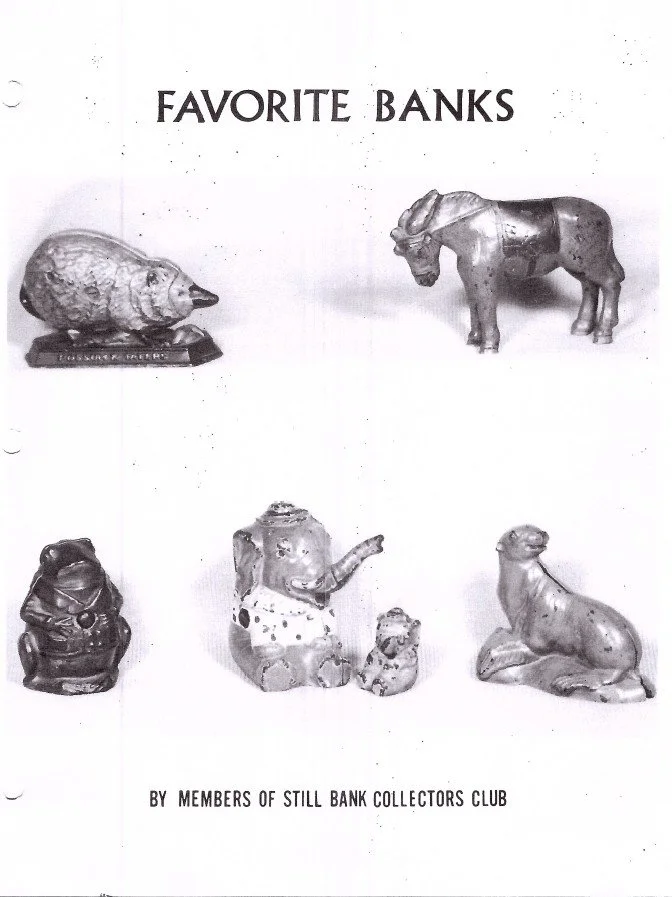
1970 - Convention #3
Our Favorite Banks Booklet
A special club publication organized by Dick Hale. The booklet consisted of photos of member’s 10 favorite banks.
“This Handbook presents a photographic array of our favorite banks, some ordinary and some quite extraordinary. The participants selected them thoughtfully either for their associative significance, visual appeal, historical implication or scarcity.
Some provided detailed descriptions of the banks and a few related their experiences in acquiring them. However, in order to provide uniformity the banks are simply designated by name and by material if it is other than cast iron.”
William Werbell
Elaine Werbell
January 1970
-
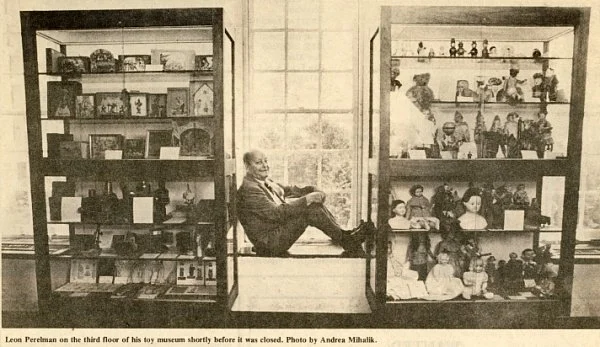
1971 - Convention #4
Visit to Leon Perelman's Toy Museum
Leon Perelman was one of the most prominent early American collectors of mechanical and still banks, and his private toy museum in Philadelphia became an important destination for collectors and scholars during the mid-twentieth century. Assembled over decades, Perelman’s collection was widely regarded as one of the finest of its kind, featuring rare nineteenth-century cast-iron mechanical banks, still banks, and other antique toys. His museum—privately maintained but occasionally opened to enthusiasts—helped elevate the study of toy banks from casual collecting to a more serious historical pursuit, influencing a generation of collectors who would later form organizations such as the SBCCA and the MBCA.
In 1968, Perelman made the decision to sell his renowned collection, an event that had a lasting impact on the hobby. The dispersal brought many exceptional and previously unseen pieces into the broader marketplace, dramatically increasing awareness, scholarship, and competition among collectors. The sale is often viewed as a turning point in the evolution of toy bank collecting in the United States, helping to establish stronger market values and encouraging more formal documentation and research. Many pieces from the Perelman collection went on to become centerpiece holdings in other major collections, further extending his influence well beyond Philadelphia and solidifying his legacy as a foundational figure in the history of still and mechanical bank collecting.
Source: Photo featured on Mechanical Bank website from Main Antique Digest, October, 1988. The site also features a listing of Perelman Museum Mechanical Banks and their prices.
See Below for listing of Perelman Museum Mechanical Banks and their prices.
-
1973 - Convention #6
Favorite Banks II
Produced in 1973, this special Club publication was organized by Ralph Craig. The booklet featured photos of member’s favorite banks.
-
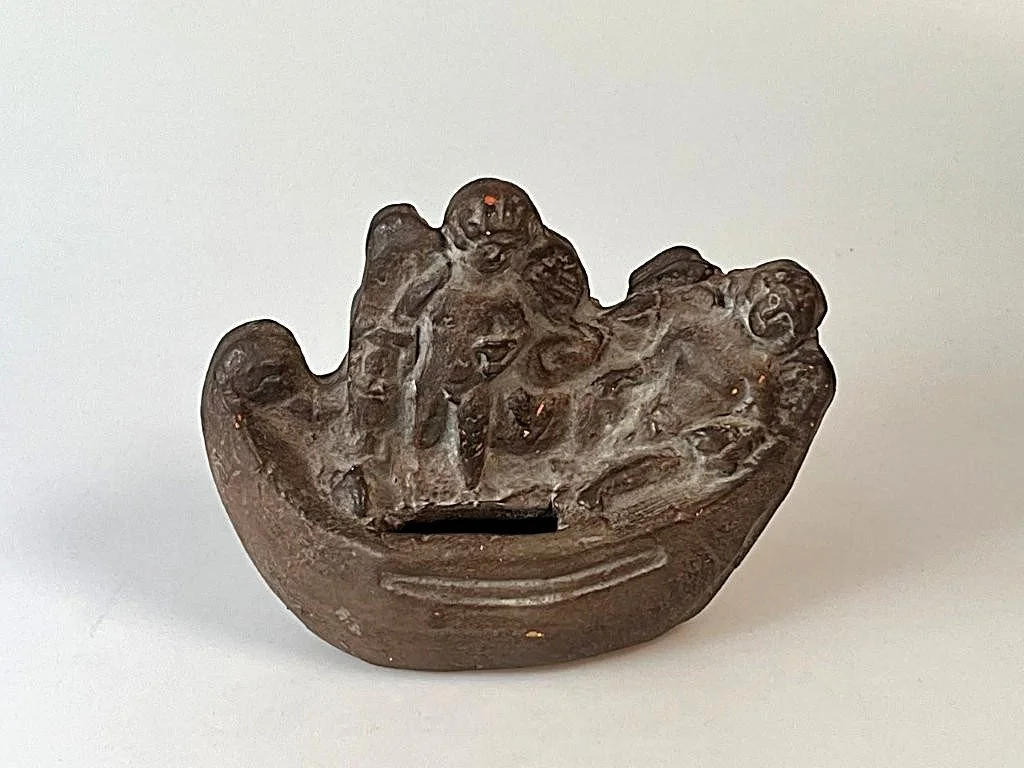
1974 - Convention #7
Two Eroica with wings on Papyrus Boat
Consistent with the theme of the convention “Still Banks from Antiquity to the Modern Era;” Gerhard Riegraf produced this replica of an antique bank in his collection.
-
1978 - Convention #11
SBCCA Photo Project
One of the Club’s most comprehensive projects organized by Bruce and Blossom Abell and Susan and Andy Moore. The project consisted of 8×10 colored composite photos of over 1,000 banks. Photos were taken over a three-year period (1977-1981). An index of the photos was compiled in 1982 by Blossom Abell.
-
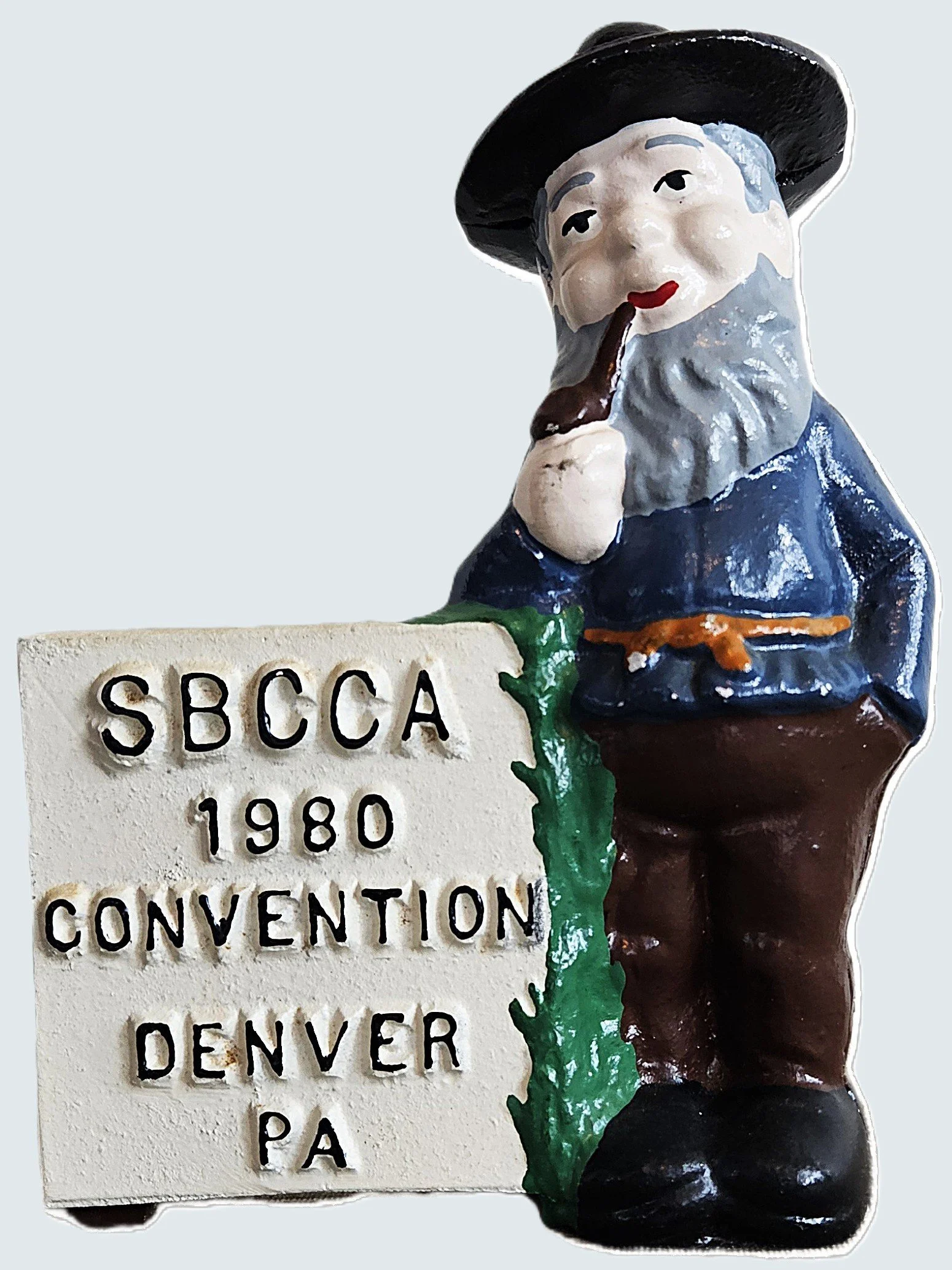
1980 - Convention #13
Amish Man Favor
Charlie Reynolds made his first still bank in conjunction with the 1980 SBCCA convention. Measuring 6 ¾ inches high and 4 ¾ inches wide, this sand-cast aluminum bank celebrates the Amish community who reside in the Lancaster. PA area (and the site of our convention). Production of this bank was limited to 50.
Additional Favor: Cedar wood bank “Puppy with Bee.” Carved by Earl Albright and stamped 1980 SBCCA Convention 1980 Denver PA (see group photo 1985).
-
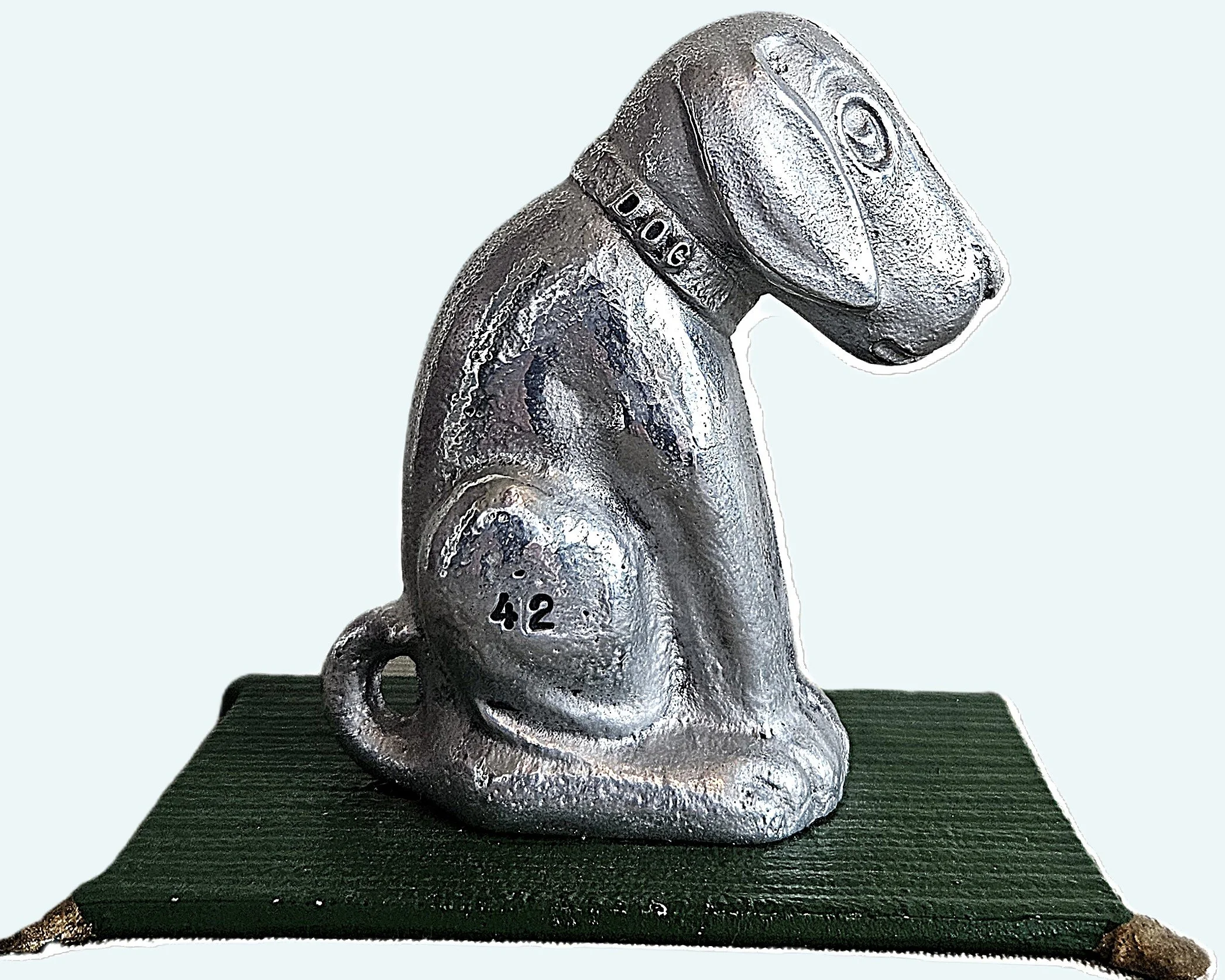
1981 - Convention #14
Deco Dog
Representing the second in a series of SBCCA Convention banks produced by Reynolds Toys, Deco Dog features a wistful pup seated on a green carpet.
The bottom of the carpet reads SBCCA June 1981 and Reynolds Toys.
Convention Favors: Ballpoint pen, 6" ruler, place magnet, screwdriver key chain.
-
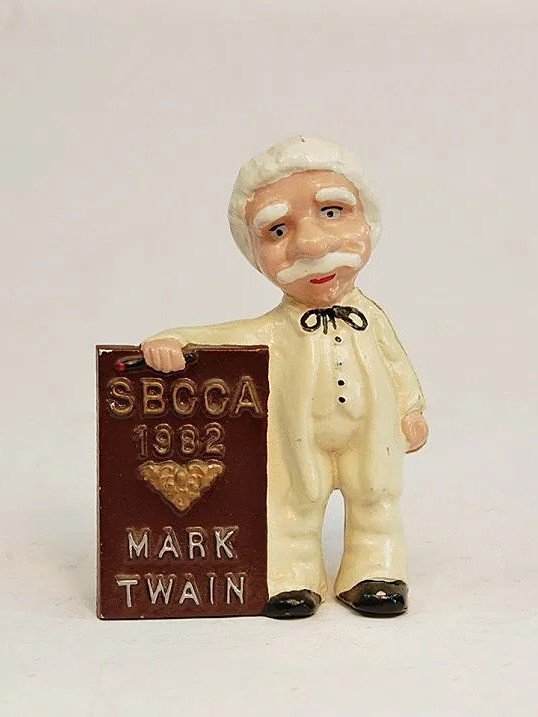
1982 - Convention #15
Mark Twain Favor
Produced by Charlie Reynolds in recognition of the 1982 SBCCA convention, the Mark Twain bank represented the third numbered limited edition Convention Bank.
Twain is dressed in a traditional white suit with a string bow tie. He is holding a cigar in hand and leaning next to a speaker’s lectern which says SBCCA 1982 and Mark Twain in the front and Reynolds Toys on the back. The coin slot is on the back of the lectern.
Made of aluminum, the bank is 5 1/4” high and 3 5/8 “ in length. It is painted in nine colors and weighs 14 ounces. Only 50 were produced. Original Costs: $40 plus $5 postage.
In addition to this bank Earl Albright provided club members with a wooden cat bank modeled after the Hubley bank). The cedar carved banks were white with light and dark hues. Trim colors varied.
-
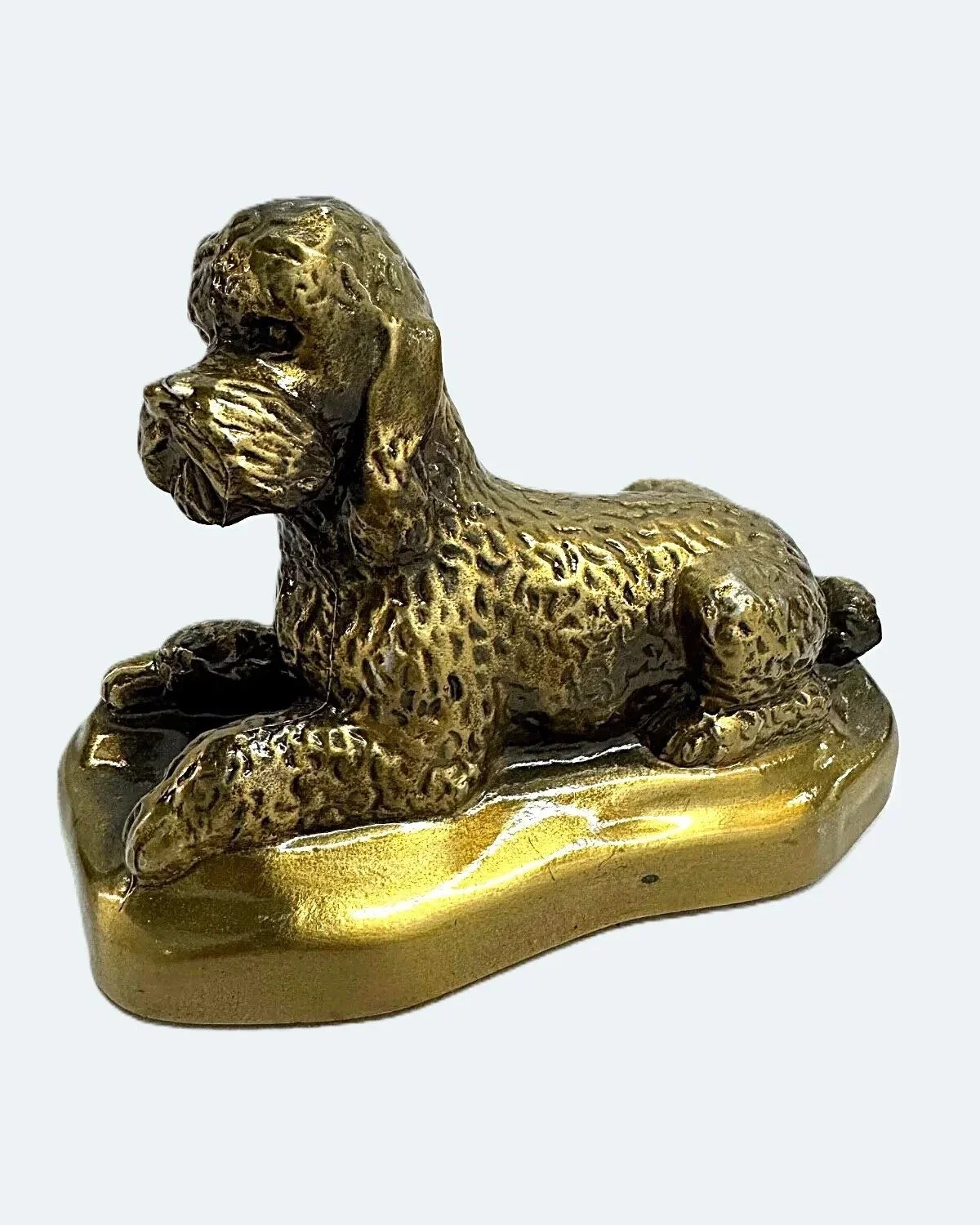
1983 - Convention #16
Banthrico Poodle Bank
Following a tour of the Banthrico Manufacturing Plant attendees received brass-plated Poodle Bank.
Banthrico Banks are slush mold products using a zinc alloy consisting of 95% Zinc and 5% aluminum. Melted in gas-fired pots, the banks are poured individually into cast-iron machine molds. Banks are then de-burred, polished and plated or painted. Most of their productions are sold to financial institutions with very little of their sales to individuals or to retail outlets.
-
1984 - Convention #17
The Kenton Hardware Foundry Booklet
Organized by Bob Saylor in 1984-85, the booklet contains the complete history of Kenton Hardware Company as it pertains to still banks. Bob Saylor was an ardent Kenton historian.
-
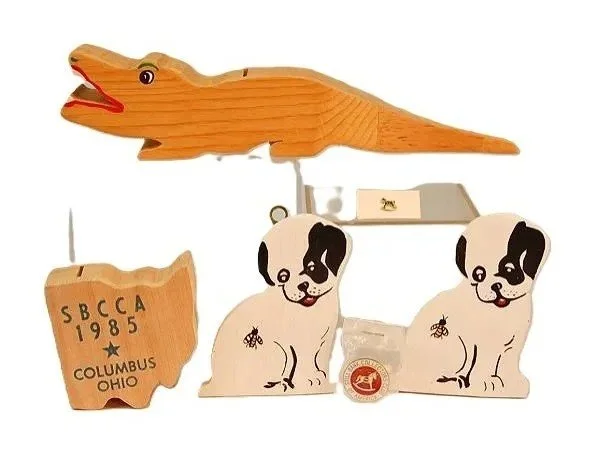
1985 - Convention #18
Cedar wood Ohio Map
Convention Favors: Kenton Hardware publication featuring the collections of Bob Sawyer, Bob & Arlene Smith, and Bill Robinson; Cedar wood Ohio map wall bank (crafted by Earl Albright).
-
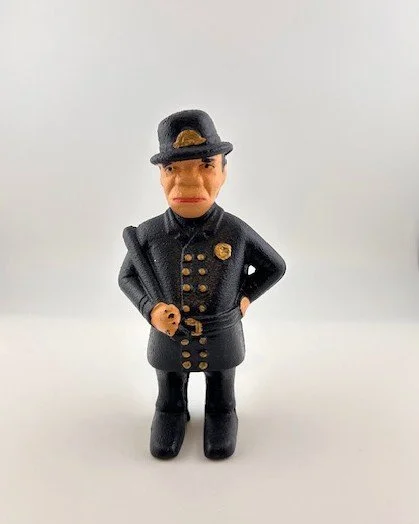
1986 - Convention #19 - Mulligan the Cop Favor
The John Wright Foundry provided each attending member with a reproduced cast iron Mulligan the Cop Bank commemorating the club’s 20th Anniversary.
Other favors included a Wooden Penny (Charlie Reynolds) and Cast-Iron Lucky Horseshoe (cast by Harry Houpt). Jim Redwine and the Gateway Penny Bank Club gave each member a carboard Bus Bank (Bi-State Transit Company).
Earl Albright presented convention attendees a wooden Amish Horse and Cart bank stamped with Happy Birthday SBCCA 1996-1986 Lancaster PA.
-
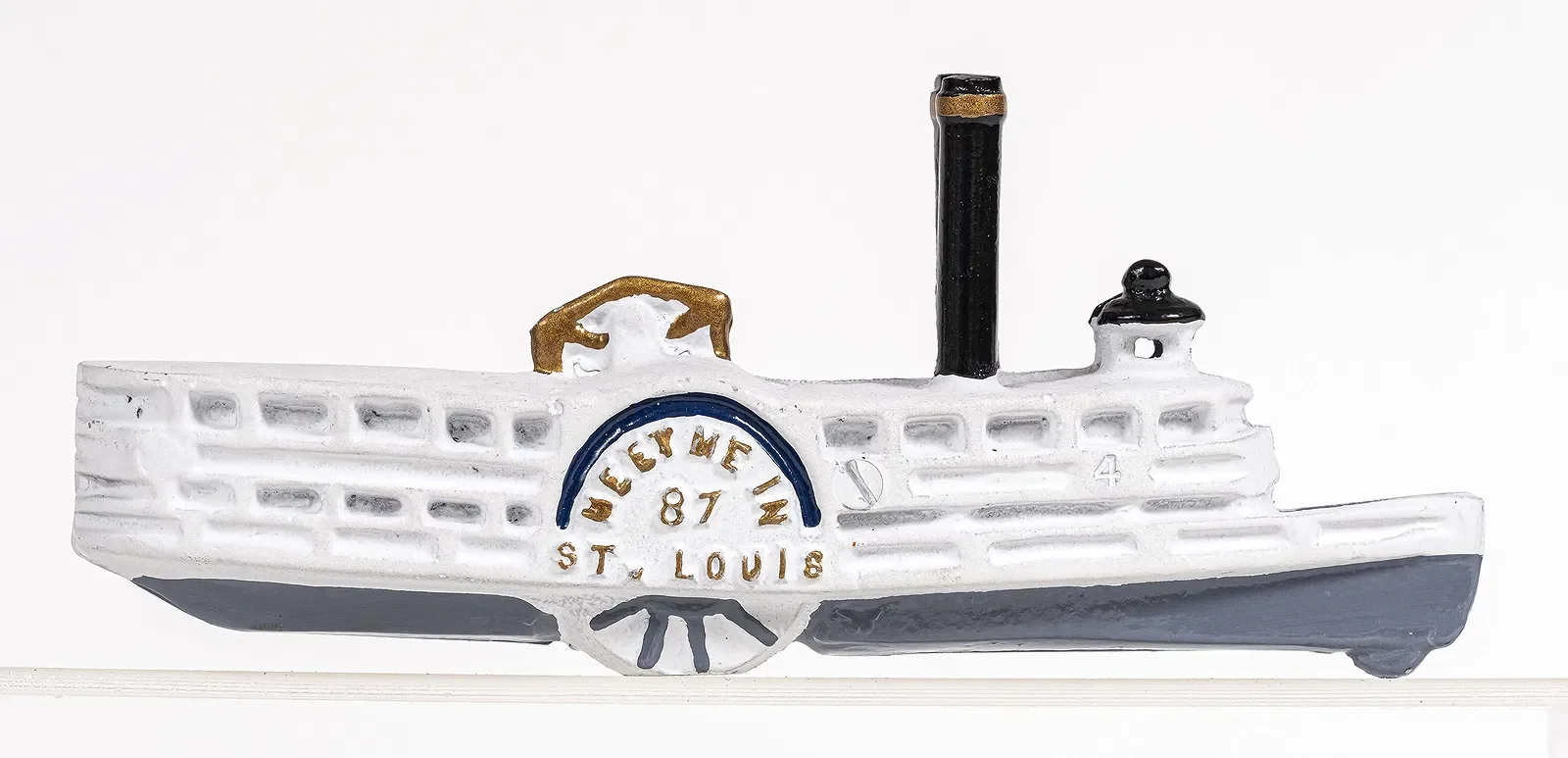
1987 Convention #20 - St. Louis River Boat Bank
Designed by Charlie Reynolds, only 60 limited edition aluminum banks were produced. The reverse side reads “Meet me in St. Louis ‘87.” A serial number was stamped for the boat number. Reynolds Toys is stamped inside.
The bank is 7 1/12” long by 3 1/4” high. It weighs 8 ounces and is painted in five colors.
-
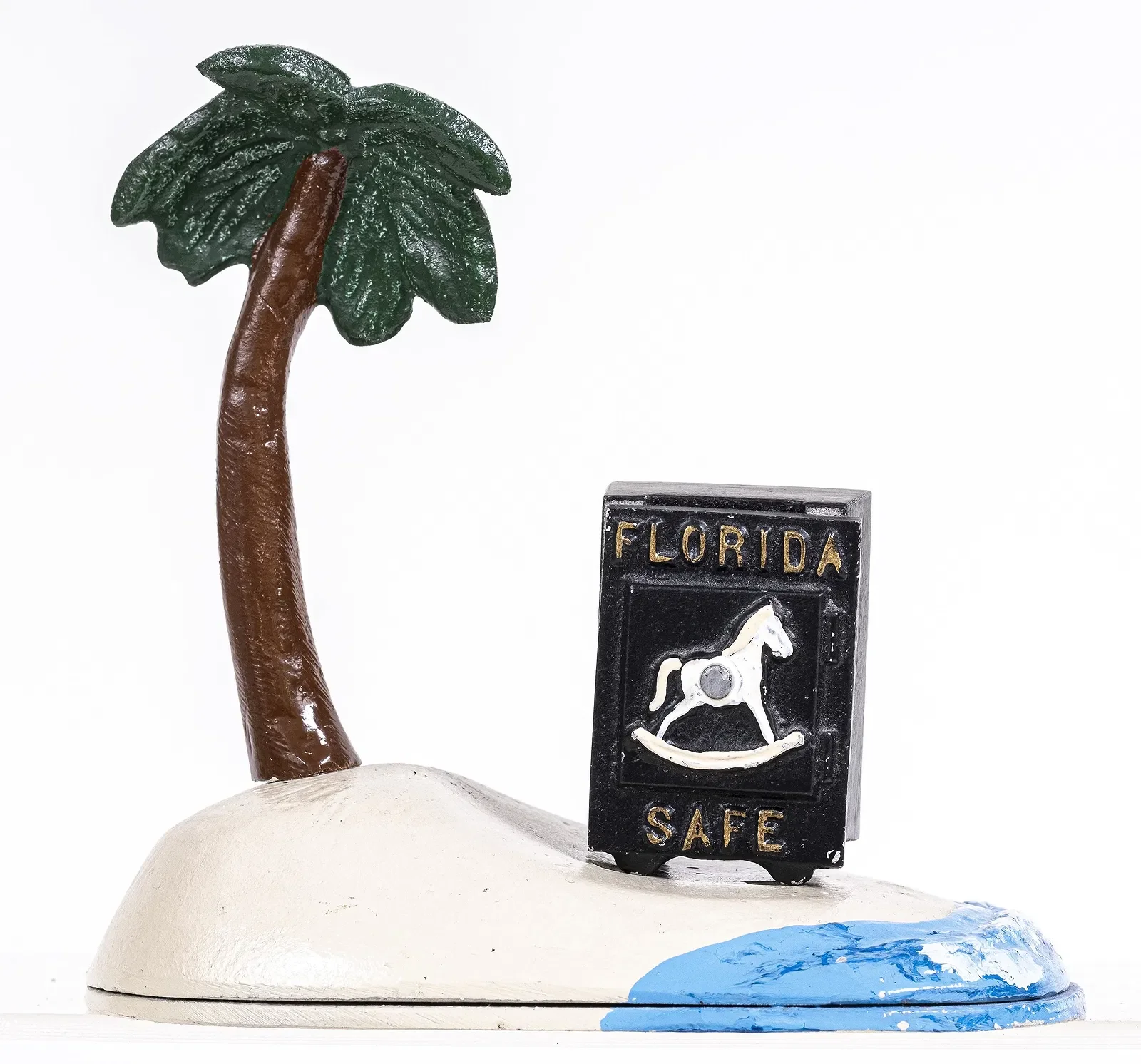
1988 - Convention #21 - Orlando Safe Bank
Beginning in 1980, Charlie Reynolds made a special bank for each SBCCA convention. This bank represents the ninth such bank. Only 75 banks were produced.
Other Convention Favors: Tulip Bank centerpiece, Alligator Bank (Earl Albright).
-
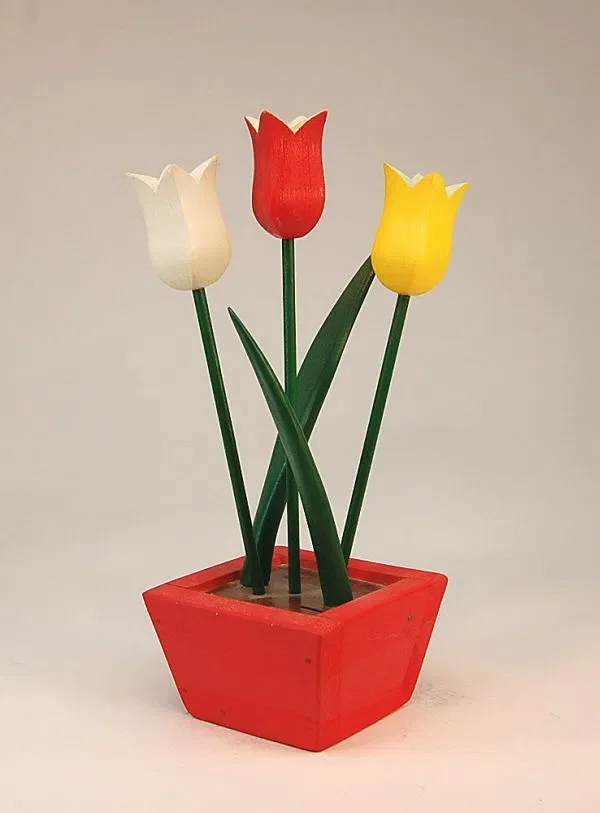
1988 - Convention #21 - Tulip Centerpiece and Alligator Bank Favor
Carved by Earl Albright, convention attendees were treated to Tulip Centerpieces at the final dinner and, being Florida, a carved alligator bank.
-
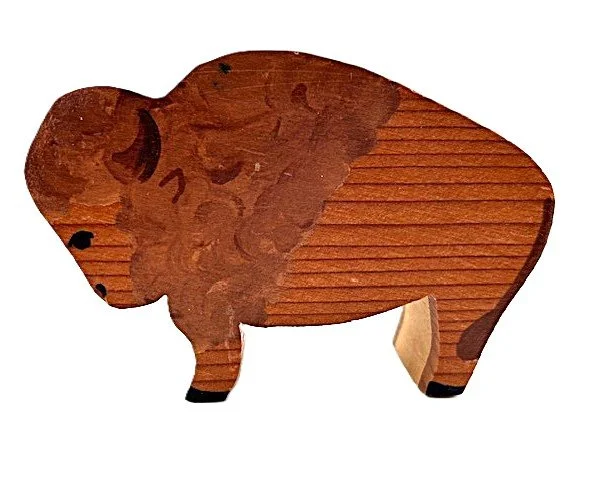
1989 - Convention #22 - Cedar wood Buffalo Bank
An Earl Albright creation, the cedar wood bank is stamped 1989 SBCCA Convention Buffalo NY on the reverse side.
-
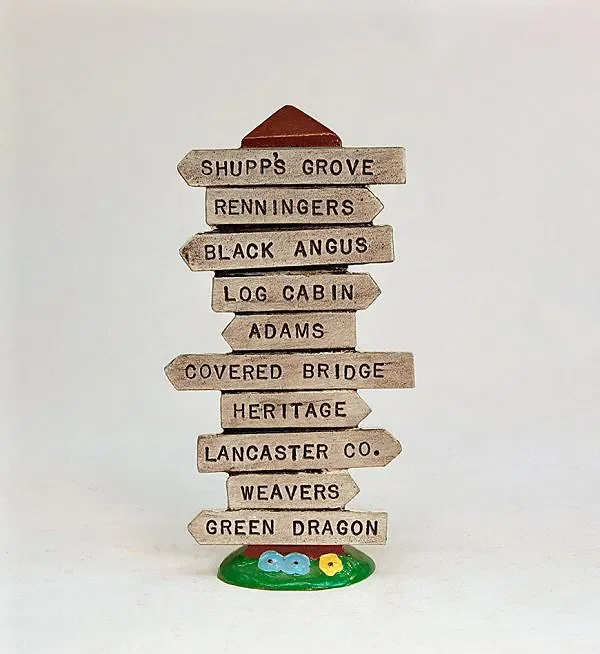
1990 - Convention #23
Sign post Bank
-
1990 - Convention #23 - Cedar Rocking Horse Favor
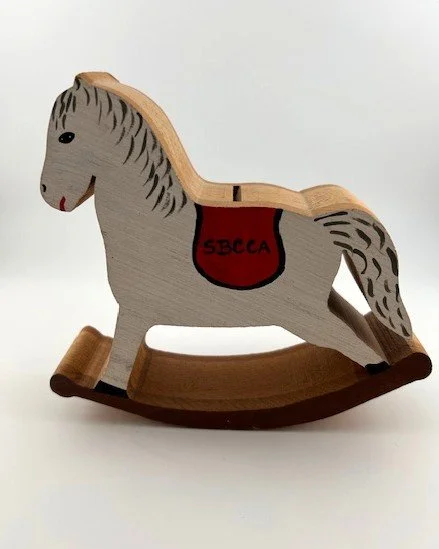
Convention Favor: Cedar wood Rocking Horse Bank (Earl Albright)
-
1991 - Convention #24 - Iron Safe Book
Compiled by Bob and Shirley Peirce, this booklet features picture of 333 cast iron safes with descriptions. The booklet was mailed to members in 1991.
-
1992 - Convention #25 - Banthrico Ford Truck
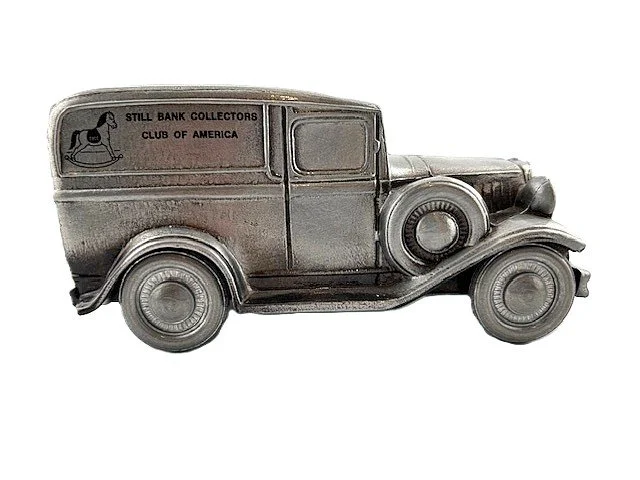
Produced by Banthrico, each bank came with a new penny taped to the bottom of the bank.
-
1993 - Convention #26 - Rehberger Bank Book
Convention Favor: Rehberger Bank Book – gifted by Bob & Shirley Pierce
-
1996 - Convention #29 - Charlie Reynolds 30th Anniversary Car
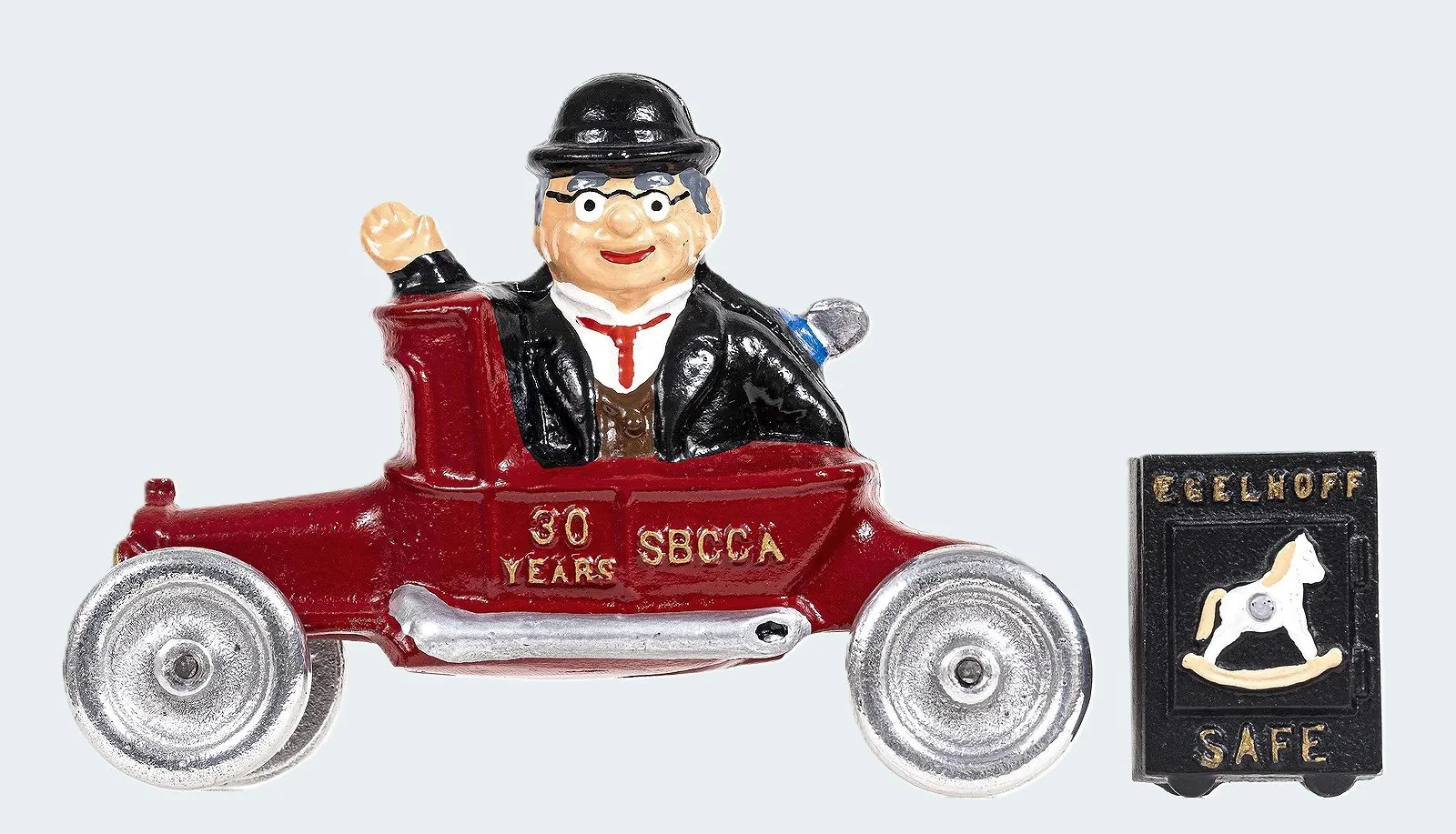
Yes. the Maple Syrup Can DID contain maple syrup!
-
1997 - Convention #30
Indianapolis, IN
📍 Ramada Indianapolis Airport
📅 June 12–14, 1997
👥 Attendance: 270Club: 504 members
SBCCA Bank: Rope and Oval Safe Bank
Convention Favor: Guide to Recognizing Damage to Still Banks booklet
Home Visit: Larry & Jeanie Egelhoff
-
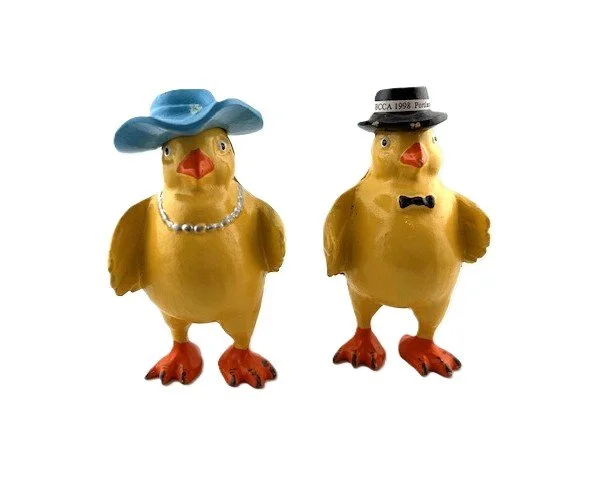
1998 - Convention #31 - Chicks
The earlier of the two SBCCA Doc Yak banks, the bank was produced by Reynolds Toys but painted locally in Portland by the Kidds.
-
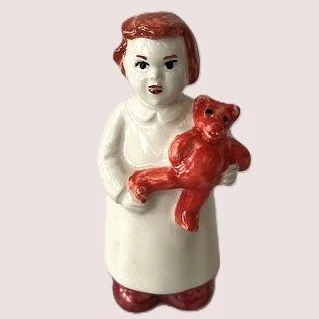
2002 - Convention #35 - Nighty Night Bank
Designed by Ulrike Riegraf-Blank and produced in Germany, this porcelain bank celebrates the 100th birthday of the teddy bear. The bank is 3 ½ Inches tall.
-
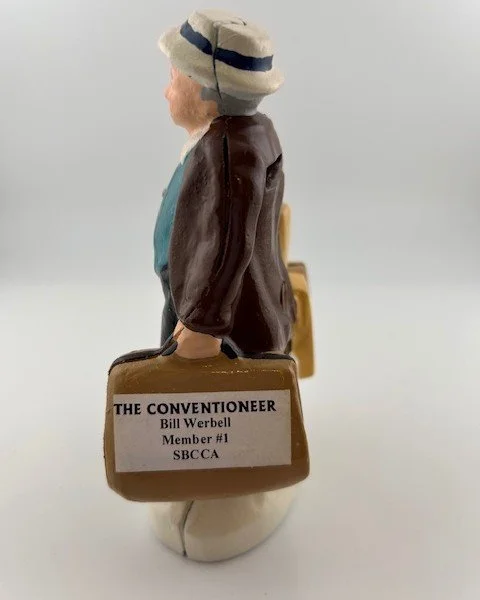
2002 - Convention #35 - Conventioneer (Bill Werbell) Bank
Convention Favors: Bill Werbel with Suitcases (Charlie Reynolds); Nighty-Night Bear Bank (Ulrike Riegraf-Blank)
-
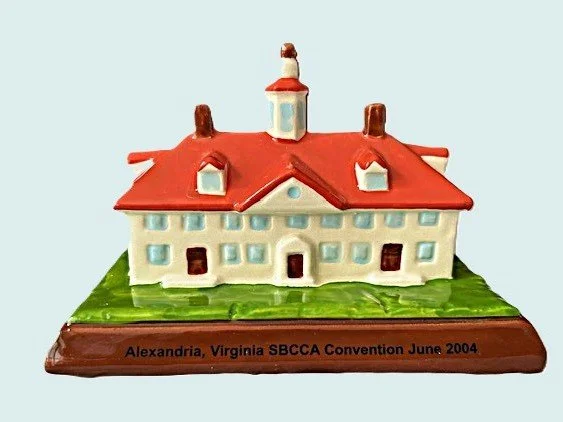
2004 - Convention #37 - Favor: Mount Vernon Bank
This porcelain bank painted in five colors was designed by Ulrike Riegraf-Blank and produced in Germany by her firm Tresor-Verlag.
The bank is regarded as one of the few Mount Vernon banks ever produced.
-
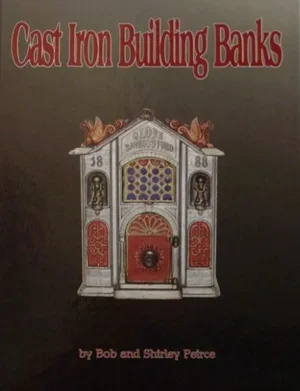
2009 - Convention #42 - Cast Iron Building Banks Book
Written by Bob and Shirley Peirce, the Cast Iron Building Banks book was made available to club members.
-
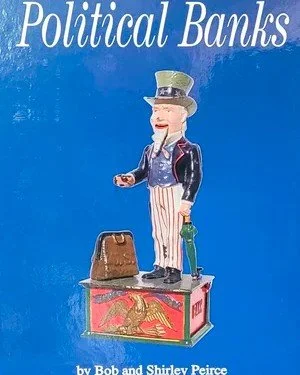
2017 - Convention #50 - Political Banks Book
Convention Favor: Distribution of “Political Banks” book by Bob & Shirley Peirce
-

2018 - Convention #51
The Safe Bank Book
Written by Mike Holz, the book offers collectors a comprehensive, well researched overview of safe banks. Complete with numerous photographs, patterns, and background information; this book is a must-have for safe bank and still bank collectors alike.